What’s New Now: Medicaid Enrollment, Homeless Services, Utilities, and Housing Assistance That Tampa Bay Families Should Know
If you or someone you care for in Tampa Bay relies on Medicaid, is looking for help with rent or homelessness, or needs guidance to keep the lights on, a lot has changed in 2024–2025 that affects how to get and keep help. Below we summarize the most important federal updates and what they mean for Florida seniors, low-income families, and caregivers, with clear steps you can take today. We base this update on current federal materials from the Centers for Medicare & Medicaid Services (CMS) and the U.S. Department of Housing and Urban Development (HUD), and on recent Medicaid demonstrations that connect health care to housing supports.
Our view: the current moment is a mix of risk and opportunity. Many people have lost Medicaid due to renewals restarting, yet new rules make it easier for children to stay covered. At the same time, HUD has released historic funding notices that Florida communities can use to expand homeless services and add housing units. For households juggling health coverage and housing costs, connecting the dots early—renewing Medicaid on time and getting on local HUD-funded pathways—can prevent gaps in care and help stabilize housing.
Medicaid enrollment: renewals, continuous coverage for kids, and expected declines
-
After three years of pandemic “continuous coverage,” states restarted normal Medicaid and CHIP renewals in 2023. CMS projects total person‑years of Medicaid enrollment to fall to about 83.5 million in FY 2024, a decrease of roughly 10.2 million compared with FY 2023, largely because the pandemic continuous coverage ended on March 31, 2023, under the Families First Coronavirus Response Act (FFCRA) [6.2 percentage point FMAP boost tied to continuous coverage] (CMS FY 2024 Congressional Justification; CMS FY 2025 Congressional Justification).
-
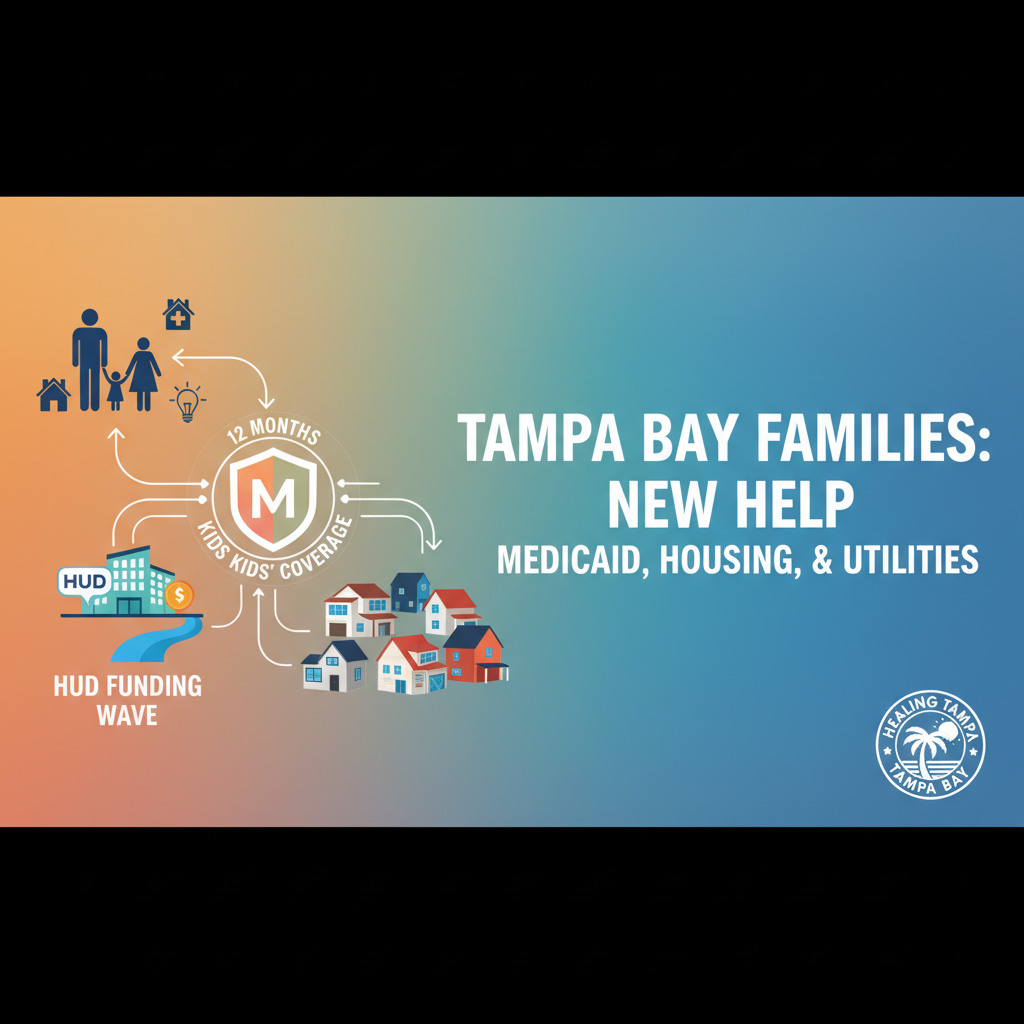
Children’s coverage remains a bright spot with a new federal protection: as of January 1, 2024, all states must provide 12 months of continuous eligibility for children under age 19 in Medicaid and CHIP, regardless of changes in circumstances during that year (CMS December 2023 guidance summarized in the FY 2025 justification). This change comes from Section 5112 of the Consolidated Appropriations Act, 2023.
-
Before renewals restarted, children’s enrollment had grown. In FY 2022, 46,396,724 children were enrolled in Medicaid and CHIP, up 3.7% from FY 2021. Medicaid child enrollment totaled 38,122,535 (up 5% year-over-year), while CHIP child enrollment was 8,274,189 and declined slightly. Growth in Medicaid children’s enrollment was tied to FFCRA’s continuous coverage; the policy did not apply to CHIP in most states, which helps explain the CHIP decline (CMS FY 2025 Congressional Justification).
-
CMS expects lower overall child enrollment totals in FY 2023–2024 than initially targeted, reflecting coverage losses during the “unwinding” renewals. CMS says future targets account for these losses and that there is intensive technical assistance to states to minimize inappropriate terminations, especially for kids (CMS FY 2025 Congressional Justification).
-
To reduce administrative churn, CMS proposed rule changes in September 2022 to simplify Medicaid/CHIP applications, eligibility, and renewals, including eliminating CHIP waiting periods and premium lock-outs and smoothing transitions between programs for children. A final rule is under development (CMS FY 2025 Congressional Justification).
Action steps for Florida Medicaid households
-
Watch your mail, email, and text messages for renewal notices. The biggest reason for terminations has been missing paperwork during unwinding. If you moved, update your address and phone with the state Medicaid office before your renewal.
-
If you care for a child under 19, ask about 12-month continuous eligibility. Federal law now requires it in every state starting January 1, 2024. If your child was cut off earlier than a year after enrollment, ask for a review or help with re‑enrollment citing the federal policy change (Consolidated Appropriations Act, 2023) as highlighted by CMS.
-
If anyone in your household is terminated and you still believe you qualify, request a fair hearing and/or reapply immediately. CMS acknowledges declines tied to unwinding and is urging states to minimize losses of eligible people (CMS FY 2024 Congressional Justification; CMS FY 2025 Congressional Justification).
Healing Tampa Bay can help you prepare renewal paperwork and troubleshoot denials.
Homeless services and housing assistance: HUD’s 2024–2025 funding wave
HUD has released an unprecedented set of grants and vouchers that local Continuums of Care (CoCs), housing authorities, and nonprofits use to expand services and housing options for people experiencing or at risk of homelessness:
-
In January 2024, HUD awarded $3.16 billion in CoC Competition Awards nationwide, including about $136 million in Youth Homelessness Demonstration Program (YHDP) renewals/replacements and more than $57 million for new projects serving survivors of domestic and sexual violence (HUD FY 2024 Annual Performance Report).
-
In July 2024, HUD released a $3.5 billion Continuum of Care Program notice of funding opportunity. For the first time, it is a single application covering FY 2024 and FY 2025—reducing administrative burden and allowing communities to focus more on service delivery (HUD FY 2024 Annual Performance Report).
-
Also in July 2024, HUD launched “CoCBuilds,” a $175 million funding opportunity to add new units and reduce homelessness in CoC areas (HUD FY 2024 Annual Performance Report).
-
In FY 2023, HUD awarded $2.8 billion in CoC awards, plus $486 million in grants and $43 million in Stability Vouchers to address unsheltered and rural homelessness, a first‑of‑its‑kind initiative targeting people in encampments and rural areas. HUD also added $60 million in new YHDP communities and maintained support for survivors of violence (HUD FY 2025 Annual Performance Plan & FY 2023 Annual Performance Report).
-
HUD emphasizes that housing is foundational to health, recovery, and economic success and is pursuing an “all of government” approach aligned with the federal strategy “All In” to prevent and end homelessness (HUD FY 2025 Annual Performance Plan & FY 2023 Annual Performance Report).
What this means for Tampa Bay residents
-
If you are unsheltered or in shelter, ask to be assessed through your local CoC’s coordinated entry system. The big 2024–2025 CoC funding rounds position communities to expand supportive housing, rapid rehousing, and services. Coordinated entry is your front door to those resources. HUD’s latest funding notices and awards underscore that communities should be scaling placements now (HUD FY 2024 Annual Performance Report).
-
If you are a youth or young parent facing homelessness, ask specifically about YHDP-funded programs, which continue to receive targeted funding in renewals and expansions (HUD FY 2024 Annual Performance Report; HUD FY 2025 Annual Performance Plan & FY 2023 Annual Performance Report).
-
If you are a survivor of domestic violence, dating violence, sexual assault, or stalking, ask about new DV‑dedicated projects funded in the CoC awards. HUD expanded these in both 2023 and 2024 awards (HUD FY 2025 Annual Performance Plan & FY 2023 Annual Performance Report; HUD FY 2024 Annual Performance Report).
-
If you live with HIV and are homeless or at risk, ask local providers about HOPWA opportunities. HUD awarded additional HOPWA funding in FY 2023 and FY 2024 to expand stable housing for persons with HIV (HUD FY 2025 Annual Performance Plan & FY 2023 Annual Performance Report; HUD FY 2024 Annual Performance Report).
Healing Tampa Bay can connect you to coordinated entry and help you gather documents typically requested during housing assessments.
Medicaid’s growing role in housing-related supports (and what Florida families should watch)
Across the country, an important shift is underway: states are using Medicaid Section 1115 demonstrations to integrate housing-related services for people with serious mental illness (SMI) or other complex needs. These are not rent payments, but they can cover services that help people obtain and keep housing.
-
As of February 2024, 12 states and D.C. had approved 1115 SMI/SED demonstrations. Common strategies include assessing housing needs during inpatient discharge, supporting case management, and connecting people with supportive housing and supported employment. Some states finance housing transition and tenancy supports through 1915(c) or 1915(i) benefits alongside 1115 demonstrations (RTI International report for Medicaid, May 2025).
-
Washington’s 1115 demonstration requires managed care organizations to screen for housing instability within 60 days of enrollment and to coordinate with housing agencies. The state runs supportive housing and employment services; by March 2019 about 1,991 beneficiaries were enrolled in supportive housing under Initiative 3, with non‑traditional providers participating (Washington 1115 materials).
-
Washington’s current 1115 approval (through June 2028) includes Foundational Community Supports benefits; the state is authorized to limit slots for those benefits, which indicates a structured, targeted scale‑up approach (Washington 2.0 1115 approval).
-
Nevada (proposal submitted November 27, 2024) seeks to add housing and nutrition supports for Medicaid enrollees experiencing or at risk of homelessness, tied to expanding behavioral health care and the IMD waiver for SMI treatment (Nevada 1115 amendment request).
-
Montana’s “Heart” demonstration approval includes tenancy supports and behavioral incentives (contingency management), allowed on a geographically limited basis under approved waiver authority (Montana 1115 approval).
Why this matters in Florida: Even where rent is not covered by Medicaid, these demonstrations show a practical path to stabilize people with high needs—using services like housing transition navigation, tenancy sustaining, recuperative care after hospitalizations, and employment supports. CMS has also clarified nationally that Medicaid can complement, but not replace, housing dollars, and has proposed simplifying eligibility and renewals to reduce churn. Families in Florida should watch for any state announcements on Medicaid demonstrations that expand housing-related supports, and, in the meantime, ask managed care plans and providers about screening for housing instability and referrals to HUD-funded programs. The national trend is clear in the federal materials: health and housing supports are increasingly coordinated (RTI report on SMI/SED demonstrations; CMS FY 2025 Congressional Justification).
Utilities assistance: how to navigate when federal updates are housing‑focused
Recent federal releases we reviewed are concentrated on Medicaid enrollment and HUD homeless/housing funding. While they do not detail a specific new federal utility aid program, here are practical moves tied to the same systems:
-
When you engage with your local CoC’s coordinated entry, ask if any HUD-funded programs in your area include help related to move-in costs. Providers often bundle housing stabilization services within CoC projects funded by the awards highlighted above (HUD FY 2024 Annual Performance Report).
-
If you are exiting a hospital or residential treatment and struggle to maintain utilities, discuss “recuperative care” and short-term post-hospital housing supports where available through Medicaid demonstrations in some states. While availability varies by state, this category of service appears in approved/expanded demonstrations like Washington’s, alongside tenancy supports (Washington 1115 materials).
Healing Tampa Bay will help you ask the right questions locally and connect with programs that use current HUD and Medicaid funding to stabilize housing, which is the first step toward managing utility costs.
For caregivers of children and older adults: keep coverage steady and link to housing services
-
Children: Use the 12-month continuous eligibility rule to preserve kids’ coverage and regular care. If your child loses coverage within a year of enrollment, ask for help re-establishing it based on the new federal requirement effective January 1, 2024 (CMS FY 2025 Congressional Justification).
-
Older adults: If a hospitalization is followed by unstable housing or homelessness, ask discharge planners and your plan about referrals to supportive housing and, where available, short-term post-hospital housing supports included in some states’ Medicaid demonstrations. Federal reports show the model is expanding nationally, even if specifics differ by state (RTI report on SMI/SED demonstrations).
-
People with serious mental illness: Document housing needs early. Demonstrations in multiple states explicitly require housing assessments and support coordination as part of care management, improving the chance you’ll be referred for supportive housing or employment services that can stabilize your situation (RTI report; Washington 1115 materials).
How Healing Tampa Bay can help you act now
-
Medicaid renewals and applications: We can help you gather documents and submit renewals to avoid coverage gaps. With CMS projecting declines due to unwinding and actively urging state fixes, persistence matters (CMS FY 2024 Congressional Justification).
-
Keeping kids covered: We will help you use the new 12-month continuous eligibility for children under 19 to your advantage and check whether your child was cut off in error (CMS FY 2025 Congressional Justification).
-
Homeless and housing services navigation: We will connect you to your CoC’s coordinated entry and help you ask about the new HUD-funded opportunities (CoC awards, CoCBuilds, Stability Vouchers, YHDP, HOPWA) that local providers can leverage now (HUD FY 2024 Annual Performance Report; HUD FY 2025 Annual Performance Plan & FY 2023 Annual Performance Report).
-
Coordinating health and housing supports: Based on emerging best practices from state Medicaid demonstrations, we’ll help you talk to your health plan and providers about screening for housing instability, post-hospital supports, and tenancy services where available, and we’ll pair that with HUD-funded housing pathways locally (RTI report on SMI/SED demonstrations).
Bottom line
-
Expect continued churn in adult Medicaid enrollment as renewals proceed, and act early to keep coverage. Children have new protections: 12 months of continuous eligibility across the board in 2024, which you can and should use.
-
HUD has opened the funding spigot for communities to scale homeless services and add housing. Getting into coordinated entry is the fastest path to be matched to HUD-funded assistance available in your area right now.
-
Medicaid and housing are converging through 1115 demonstrations—not to pay rent, but to provide the services that make housing stability possible. Ask your providers and plans to screen for housing needs and refer you into these supports alongside HUD programs.
If you’re in Tampa Bay and need help with any of the above, contact Healing Tampa Bay. Our team will walk you through Medicaid renewals, link you to homeless services and housing resources funded under the latest HUD awards, and help you ask the right questions about housing supports in care plans—so your household can stay covered, housed, and on track.