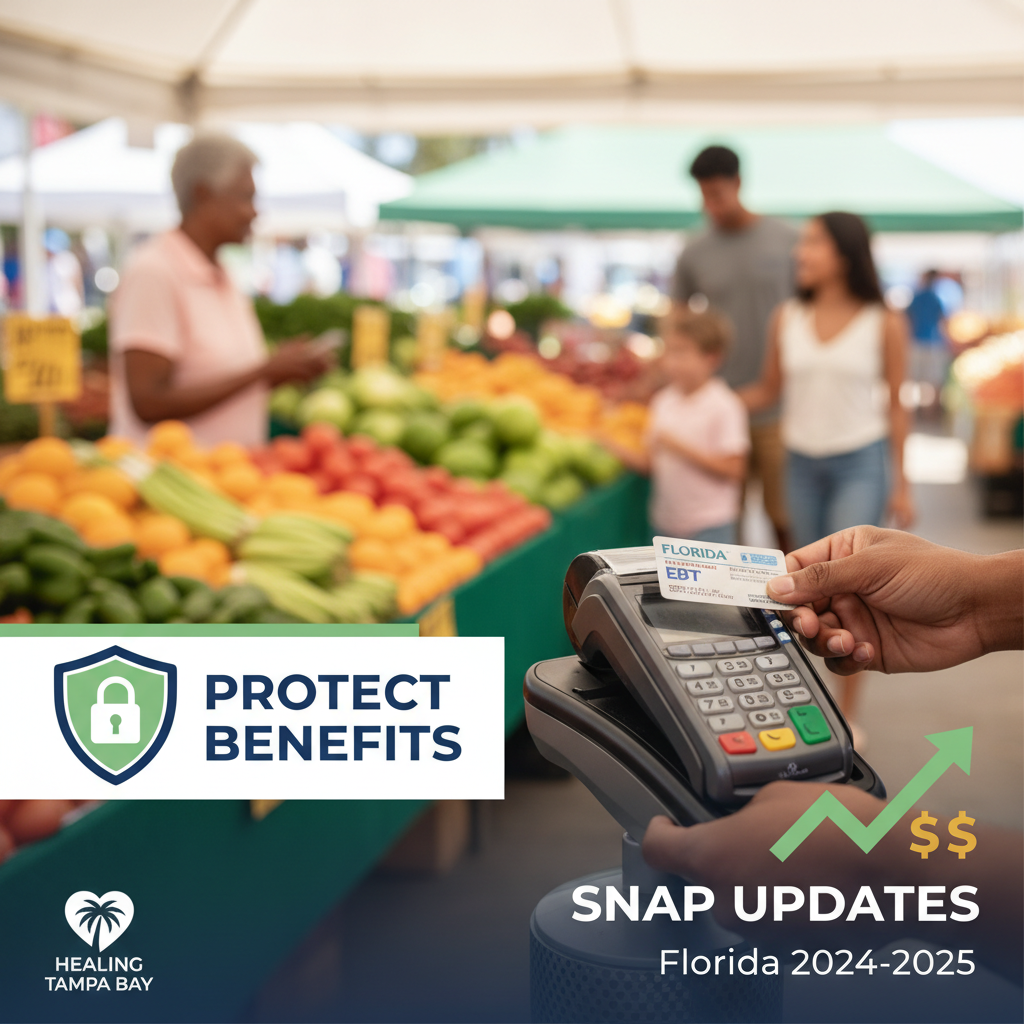
If you rely on SNAP (Food Stamps) in Florida—or you help a senior, neighbor, or family member who does—this fall has brought a few important updates to benefit amounts, fraud protections, and what to expect if federal budget talks stall. Our Healing Tampa Bay outreach team tracks these changes daily so you don’t have to. Below is a clear, practical roundup of what’s new, what’s next, and how to protect every dollar on your EBT card.
What changed for SNAP benefit amounts
-
FY 2025 benefit levels (effective Oct. 1, 2024): The U.S. Department of Agriculture (USDA) adjusted SNAP for inflation starting October 2024. According to USDA’s official cost-of-living adjustment (COLA) memo, the maximum monthly allotment for a family of four in the 48 states and D.C. is $975, with the minimum benefit set at $23. Alaska, Hawaii, Guam, and the U.S. Virgin Islands have different maximums due to higher food costs; for example, a family of four max ranges from $1,258 to $1,953 in Alaska, $1,437 in Guam, and $1,254 in the U.S. Virgin Islands, while Hawaii’s max is $1,723. See USDA’s summary of the FY 2025 changes in SNAP FY 2025 Cost-of-Living Adjustments.
-
FY 2026 updates (effective Oct. 1, 2025): USDA has issued the next round of COLAs as required by law, effective October 2025, which update SNAP maximum allotments, income standards, and deductions. While USDA’s resource page notes these FY 2026 COLAs are in effect now, always check your official notice or EBT balance for your exact benefit as calculations vary by household size, income, and deductions. See USDA’s resources page noting FY 2026 COLAs under FNS Documents & Resources.
What this means for you: If your household circumstances are the same, your SNAP amount should reflect the updated COLAs. If your income, household size, or expenses changed, report those changes to your state agency promptly so your calculation is accurate.
Could a federal shutdown affect your EBT?
Budget standoffs in Washington can create anxiety about SNAP timing. According to the White House’s ongoing shutdown updates, USDA has indicated that SNAP can face pressure if Congress does not pass a continuing resolution in a timely way; in one recent update, the administration noted that while October benefits were protected, “current funding may be insufficient to provide full benefits for November unless a continuing resolution is enacted very soon” (Government Shutdown Clock – The White House). Trade associations that serve grocers have also warned that shutdowns can disrupt SNAP operations for retailers and customers alike.
Our take: While SNAP is a mandatory program, the logistics of issuing benefits can be disrupted when appropriations lapse. If a shutdown is looming, keep an eye on your EBT account and watch for text/mail notices from Florida’s state agency. Healing Tampa Bay will also post updates and can help you troubleshoot if you see delays.
Practical steps during a shutdown risk:
- Check your EBT balance and transaction history more frequently.
- Shop earlier in your issuance cycle when possible.
- Keep receipts in case of system errors.
- If you can, build a small shelf-stable buffer (beans, rice, canned vegetables) without overspending.
Replacing stolen EBT benefits: what’s still possible
Skimming and cloning have affected SNAP households nationwide. Congress authorized replacements for certain stolen benefits through the Consolidated Appropriations Act of 2023. USDA’s guidance states that when a state’s plan is approved, it may replace benefits stolen by skimming, cloning, or similar fraud methods for thefts occurring between Oct. 1, 2022 and Sept. 30, 2024 (Replacement of SNAP Benefits in the Consolidated Appropriations Act of 2023). The USDA page (updated Mar. 12, 2025) emphasizes:
- Eligible theft types include card skimming, card cloning, and similar scams like phishing texts and fraudulent calls.
- Replacement with federal funds covers thefts within that Oct. 2022–Sept. 2024 window for states with approved plans.
What this means now: The federally authorized replacement window has closed for thefts after Sept. 30, 2024. However, if your theft occurred within the eligible window and you have not filed yet, contact the state agency immediately. Be prepared with dates, locations, and any receipts. For questions beyond what Florida posts, USDA points households and agencies to their regional offices as needed.
Protecting your EBT from skimming and fraud
USDA has expanded anti-fraud guidance and state coordination due to the rise of skimming. Many states are upgrading card security, and USDA’s Special Investigations Unit actively flags suspicious transactions and locations where cloned cards are used (Addressing Stolen SNAP Benefits). To reduce your risk:
- Memorize your PIN and cover the keypad at checkout and ATMs.
- Avoid non-bank ATMs and look for tampering (loose card slots, unusual overlays).
- Change your PIN regularly—especially after using a new terminal.
- Do not click on links in texts/emails claiming to be the state unless you verify the source. Report phishing attempts.
- Review transactions in your EBT portal or app weekly and report suspicious activity immediately.
USDA’s anti-fraud hub outlines how they pursue retailer fraud and trafficking and provides resources on prevention and enforcement actions (SNAP Fraud Prevention). If a store asks for your card to be swiped outside your view, or offers cash for your benefits, that’s fraud—walk away and report it.
Using your EBT: farmers’ markets and more
SNAP can stretch farther when you access discounts or incentives.
- Farmers’ markets: USDA supports equipment and resources that let markets accept EBT, which can help you buy fresh produce locally. Learn about EBT connectivity and market participation under EBT & Farmers’ Markets. Many Florida markets also offer “Double Up” or similar incentives funded by nonprofits or local partners; ask your market info booth if an EBT match is available.
- Retailers and third-party processors: If a store accepts EBT, it must follow strict rules on allowable items and fees. USDA maintains guidance for retailers and third-party processors under SNAP EBT. If you suspect a store is charging sales tax on SNAP foods or adding illegal fees, report it to the state and USDA.
Tip: Choose “food items” eligible under SNAP (groceries, not household goods or hot prepared foods). Sticking to whole ingredients and store brands can help your monthly allotment go further.
Disaster SNAP (D-SNAP) if storms strike
Florida’s hurricane season can trigger Disaster SNAP (D‑SNAP) in impacted counties once USDA and the state approve it. The USDA has updated D‑SNAP income eligibility standards for FY 2025 (effective Oct. 1, 2024) and maintains current guidance to help states stand up D‑SNAP quickly after a disaster (FNS Documents & Resources – D‑SNAP notice). If your household experiences disaster-related income loss, food loss, or expenses, watch for state announcements on D‑SNAP application locations and dates.
What to gather if D‑SNAP opens:
- ID for the head of household
- Proof of address in the disaster area
- Records of disaster-related expenses (repairs, temporary shelter, lost income)
- A simple list of food lost due to power outage or damage
Our team can help you prepare documents and get to the right site, especially for seniors and families without transportation.
Enrollment basics and eligibility: how to apply with confidence
While the exact income limits and deductions change annually with COLAs, the process to apply is consistent. USDA’s FY 2025 memo provides the official framework for income eligibility standards and deductions beginning Oct. 1, 2024 (SNAP FY 2025 Cost-of-Living Adjustments). Here’s a practical checklist to get started or recertify:
- Identity and residence: State ID/driver’s license and proof you live in Florida (utility bill, lease, or official mail).
- Income: Most recent pay stubs, benefit letters (Social Security/SSI), or self-employment records. If hours fluctuate, gather at least the last 4–6 weeks.
- Expenses: Rent or mortgage statement, utilities, child support paid, and medical expenses for seniors/people with disabilities (these may increase your benefit through deductions).
- Household details: Names, dates of birth, and Social Security numbers for everyone applying.
Tips to speed approval:
- Report changes immediately—USDA emphasizes timely processing and reporting under its “Ensuring Timely Benefits” policy framework in SNAP EBT resources.
- Keep copies of everything you submit.
- If you face a delay or can’t complete an interview, document each call or upload attempt.
If your case is denied or closed and you believe it’s in error, you have the right to appeal. We can help you review the notice and file a fair-hearing request.
For seniors and caregivers: protecting benefits and simplifying recertification
Seniors often face unique challenges with fixed incomes and medical costs. While pandemic-era increases ended years ago, USDA continues to update standard deductions and income thresholds with each COLA cycle, which can affect net income calculations for older adults with medical expenses. If you’re caring for a senior:
- Track recurring medical costs (prescriptions, co-pays, supplies) that may be deductible.
- Ask us for help organizing a recertification packet—complete, well-documented applications are processed faster and reduce back-and-forth with the agency.
If a caregiver shops for a senior, change the EBT PIN regularly and consider setting up a consistent shopping routine at trusted retailers to reduce fraud risk (see Addressing Stolen SNAP Benefits).
Policy watch: how our team uses AI to keep you up-to-date
We use AI-powered monitoring to scan authoritative USDA updates and budget developments and flag changes that affect Florida households in real time. That includes:
- COLA memos and attachments when USDA posts them (FY 2025 COLA and USDA’s resources noting FY 2026 updates)
- Anti-fraud guidance and modernization efforts in SNAP EBT
- Federal shutdown alerts and potential timing risks to SNAP from the White House’s shutdown updates
- Disaster SNAP notices tied to hurricanes and other events
This lets us guide you quickly—what to expect on issuance day, how to document a theft within eligible windows, and what to do when systems are strained.
Quick answers we’re giving families today
-
Will my benefits go up this fall? USDA has issued FY 2026 COLAs effective Oct. 1, 2025; your exact amount depends on your household’s current calculation. Check your notice or EBT balance, and call us if it looks off. See USDA’s updates under FNS Documents & Resources.
-
Can I still replace stolen benefits? Federal replacement with USDA funds covered thefts between Oct. 1, 2022 and Sept. 30, 2024 in states with approved plans. If your theft happened in that window and you haven’t filed, act immediately. See USDA’s guidance at Replacement of SNAP Benefits in the Consolidated Appropriations Act of 2023.
-
What if a shutdown happens? The White House has warned of potential disruptions if Congress fails to extend funding; in past updates, USDA noted October benefits were protected, but later months could be at risk without a continuing resolution (Government Shutdown Clock). We’ll publish Florida-specific guidance if anything changes.
-
Where can I use my EBT beyond supermarkets? Many farmers’ markets accept EBT and some offer matching dollars. USDA’s program support is outlined under EBT & Farmers’ Markets. Ask your local market about EBT incentives.
How Healing Tampa Bay can help you today
- One-on-one SNAP enrollment and recertification support
- Documentation checklists and budgeting tips to maximize deductions
- Guidance if you suspect skimming or see odd transactions
- Disaster SNAP updates if hurricanes impact your county
- Connections to other local resources (energy help, rental aid, free or low-cost cell options) to stabilize your budget while you feed your family
If you’re a senior, caregiver, or a family on a tight budget, don’t go it alone. We follow USDA’s real-time updates closely—like the COLA changes in FY 2025, the now-closed federal window for replacing stolen benefits (USDA guidance), anti-fraud resources (SNAP Fraud Prevention), and shutdown risk signals from the White House—so you can make confident choices, protect your EBT, and keep food on the table.
Reach out to our team for a free appointment. We’ll review your situation, help you apply or recertify, and map out a plan to stretch each benefit dollar—safely and effectively.