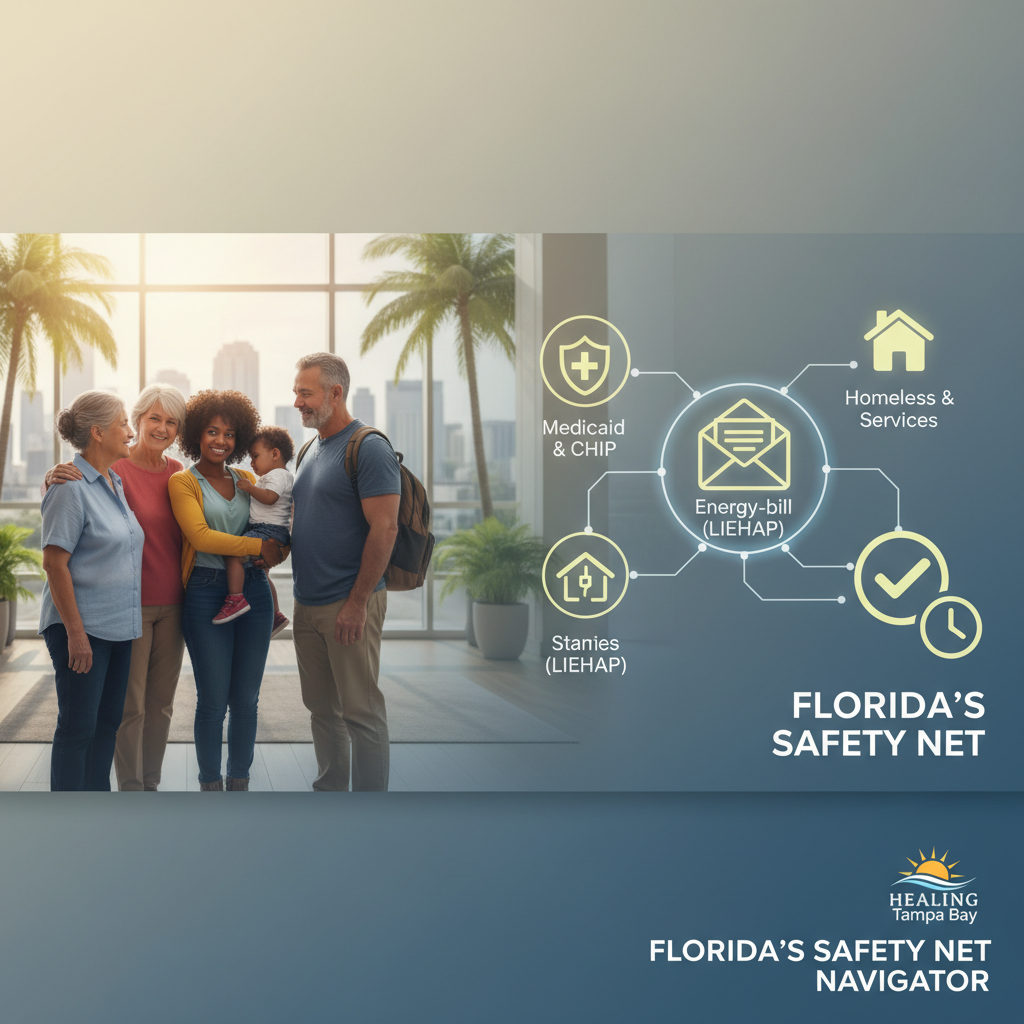
Florida seniors, low‑income families, and caregivers are navigating a fast‑changing safety net. New federal data show continued shifts in Medicaid and CHIP enrollment during the post‑unwinding period, while energy‑bill relief and homeless services remain essential for household stability heading into winter. This briefing pulls together the latest authoritative updates and turns them into practical next steps for Tampa Bay residents.
Medicaid and CHIP: what the newest national and Florida numbers say
CMS’s January 2025 Medicaid and CHIP Eligibility Operations and Enrollment Snapshot provides the most recent national view and state‑level totals. According to the January 2025 Snapshot, several trends stand out:
- Overall enrollment has come down compared with early 2024, but remains above pre‑pandemic levels. Between January 2024 and January 2025, Medicaid enrollment decreased by 5.6 million people (7%), while CHIP enrollment rose by 110,000 (1%). Compared with February 2020, Medicaid enrollment is still up by 7.3 million (11%) and CHIP by 440,000 (6%). CMS details both trends in its total monthly enrollment charts.
- Adults saw steeper declines than children. From January 2024 to January 2025, Medicaid adult enrollment fell by 2.9 million (7%), while Medicaid child + CHIP enrollment fell by 700,000 (2%). As of January 2025, 41.4 million adults and 37.4 million children were enrolled nationally (CMS Snapshot).
- Florida’s caseload has stabilized month‑to‑month. In January 2025, Florida had 3,739,787 people enrolled in Medicaid and CHIP: 3,572,785 in Medicaid and 167,002 in CHIP. Compared with the prior month, total enrollment was flat (0.0%), Medicaid ticked up 0.1%, and CHIP decreased 3% (state data table).
- Renewals remain a pressure point. In January 2025, states’ coverage retention at renewal ranged from 24% to 94%, and “ex parte” (automated, data‑check) renewal rates ranged from 9% to 86%. Disenrollment at renewal ranged from 3% to 44%, and procedural disenrollments ranged from 0% to 37% (renewal outcomes slides). Wide variation underscores how much timely paperwork and data matches affect whether people keep coverage.
These numbers are a direct result of the end of the pandemic continuous coverage requirement on March 31, 2023, which led states to resume regular renewals and terminations starting April 1, 2023. CMS continues to publish monthly performance indicators and updated renewal outcomes to promote transparency and reduce preventable losses for eligible people; see the unwinding overview and reporting notes in the CMS Snapshot and CMS’s informational bulletin on eligibility processing improvements (August 29, 2024 CIB).
What this means for Tampa Bay households
For Florida families, these trends translate into practical realities:
- Coverage is still available and relatively stable in Florida. The state’s total Medicaid + CHIP tally remained steady in January 2025, even as other states continued to see declines. That’s reassuring for parents, seniors with limited incomes, and people with disabilities who rely on Medicaid for care and long‑term supports.
- Renewals are the make‑or‑break moment. CMS reports significant procedural disenrollments (paperwork‑related losses) across states. Even eligible people can lose coverage if a renewal isn’t completed or documentation isn’t received by deadlines. This is especially challenging for people without stable housing or mail access.
- Kids’ coverage is holding better than adults’. Nationally, children’s enrollment dipped more gently than adults’ last year. Families with kids should pay close attention to CHIP eligibility and renewal notices; Florida’s CHIP enrollment did fall 3% month‑over‑month in January 2025, suggesting some churn that can often be avoided with on‑time renewals.
Bottom line: if your household’s circumstances haven’t changed much but you receive a renewal notice, responding completely and quickly is essential to stay covered.
Practical steps: applying, renewing, and avoiding common pitfalls
Based on CMS’s current reporting and guidance, a few actions can reduce the risk of losing coverage for procedural reasons:
- Watch mail and messages closely during your renewal month. CMS shows that “ex parte” automated renewals succeed for many but not all households; others must return forms or documents to stay covered. If you’re asked to return a form, do it quickly to avoid being counted as a “procedural” non‑response (CMS renewal outcomes).
- Keep proof of income, residency, and household size ready. MAGI applications are time‑sensitive. Having pay stubs, benefit letters, or other income verifications ready can shorten processing times (CMS tracks MAGI processing metrics in its eligibility operations snapshot).
- If you lose coverage, act immediately. The Snapshot shows applications in January 2025 were up 16% from January 2024, partly because people re‑apply after churn. If your coverage ends but you believe you’re still eligible, re‑apply right away to minimize gaps (applications slide).
- If you cannot complete forms due to homelessness or unstable mailing access, seek assistance. CMS emphasizes improving renewal processes and reducing unnecessary losses in its August 2024 bulletin. Community‑based assisters can help you complete renewals and gather acceptable proofs.
Our outreach team can help you gather documents, understand notices, and submit applications or renewals. If you get a termination for “procedural” reasons, contact us promptly so we can help you re‑establish eligibility if you still qualify.
Homeless services and Medicaid: why coverage matters in 2025
Community health centers (CHCs) are a lifeline for people experiencing homelessness, and Medicaid is the main coverage source that makes that care possible. A July 2025 analysis by the George Washington University’s Geiger Gibson Program highlights several points relevant for Tampa Bay’s unsheltered neighbors:
- CHCs serve large numbers of people who are homeless or housing insecure. Nearly 1.4 million health center patients (about 5%) had experienced homelessness in 2023, and about 300 of the nation’s nearly 1,400 centers receive dedicated Health Care for the Homeless funding—but virtually all serve patients experiencing homelessness (Geiger Gibson analysis, citing HRSA data).
- Health needs are higher among patients who are homeless. The report notes that patients experiencing homelessness are more likely to report needing medications, mental health care, alcohol treatment, or drug treatment in the past year than housed patients; they also have higher rates of fair/poor health, asthma, pneumonia, food insecurity, and safety concerns (Geiger Gibson findings).
- Medicaid coverage is common and crucial in this group. The analysis points to survey data indicating that CHC patients who are or have been homeless are more likely to be enrolled in Medicaid than patients who have never been homeless, making Medicaid a key determinant of access to services (Geiger Gibson).
The policy takeaway is straightforward: maintaining Medicaid coverage through complete renewals and prompt re‑applications preserves access to primary care, behavioral health, medications, and referrals that are foundational to stabilizing health and housing. The report also flags that proposed Medicaid cuts nationally could disproportionately affect people experiencing homelessness, increasing uninsurance and barriers to care; its discussion references CBO projections and HUD’s 2024 homelessness assessment (HUD’s AHAR Part 1). For Florida communities, this underscores the importance of assistance with renewals and navigation.
Utilities assistance heading into winter: LIHEAP 2025 at a glance
Energy bills strain fixed budgets, especially for seniors and families in older or inefficient housing. The federal Low Income Home Energy Assistance Program (LIHEAP) provides bill payment help, crisis assistance to prevent shut‑offs or restore service, weatherization, and minor energy‑related home repairs. The program’s overview is current as of May 7, 2025 on the Administration for Children and Families LIHEAP page.
Key practical points:
- What LIHEAP covers. LIHEAP can help with heating and cooling bills, preventing shut‑offs, reconnecting service, improving home energy efficiency, and repairing/replacing essential heating/cooling equipment (ACF overview). The LIHEAP Heating Assistance section includes outreach material links partners use to enroll eligible households.
- How to apply. For state‑specific instructions and local intake sites, visit Energyhelp.us. If you do not have internet access, call the National Energy Assistance Referral (NEAR) line at 1‑866‑674‑6327 for guidance (ACF LIHEAP).
- Fraud alert. LIHEAP never charges a fee to apply or to receive a benefit. If you are asked to pay a fee or are promised a “grant” in exchange for personal information, report it to the HHS Fraud Hotline at 1‑800‑447‑8477. ACF’s notice and additional safeguards are listed under Grant fraud and scams.
- Disaster flexibilities. If storm damage or declared disasters affect Tampa Bay this season, ACF’s Disaster Flexibilities Hub compiles the special waivers and flexibilities states can use to speed assistance.
Funding levels and income thresholds vary by state plan and season; use Energyhelp.us to find the nearest intake agency and current documentation requirements. If you receive a shut‑off notice, ask the intake worker about crisis assistance—many LIHEAP grantees reserve funds for imminent shut‑offs and medical‑need households.
Housing assistance and care coordination: models that integrate health and housing
While housing vouchers and supportive housing programs are typically administered locally (often through Continuums of Care and public housing authorities), Medicaid can play a supportive role by funding care management and certain housing‑related services that help people get and stay housed.
One example to watch—although it is in another state—is California’s Enhanced Care Management (ECM) benefit under CalAIM. ECM is a statewide Medi‑Cal managed care service that provides person‑centered, community‑based care management for members with complex needs, including people experiencing homelessness. Members are assigned a lead care manager who meets them wherever they are—on the street, in shelter, in a clinic, or at home. See the program description and fact sheet on California’s Department of Health Care Services’ Enhanced Care Management page.
California reports that 176,026 members received ECM services over the last reported 12 months (Q3 2023 to Q2 2024), supported by 2,802 contracted ECM provider arrangements statewide (CalAIM ECM highlights). While Florida’s Medicaid program is different, this illustrates a broader national trend: pairing healthcare with navigation and housing‑related supports can improve outcomes for people with high needs.
For Tampa Bay residents, the actionable insight is to use every available channel to link care and housing supports:
- If you’re experiencing homelessness, tell your healthcare provider or clinic you need help with housing‑related supports. Many CHCs and local agencies coordinate with shelters and outreach teams; the Geiger Gibson analysis underscores the role of health centers in this work.
- During Medicaid enrollment or renewal, disclose health and social needs accurately. This can influence care coordination referrals, including to community‑based partners funded to help with transitions out of homelessness.
Action checklist for Florida families and caregivers
- If you received a Medicaid renewal notice, complete and return it immediately. CMS’s latest data show many people lose coverage for procedural reasons; a fast, complete response helps avoid a gap (CMS renewal outcomes).
- If coverage ended recently, re‑apply right away. January 2025 saw 3.0 million Medicaid/CHIP applications nationally, up 16% year‑over‑year, reflecting churn and re‑enrollments (applications data).
- Struggling with energy bills? Go to Energyhelp.us or call NEAR at 1‑866‑674‑6327 to find LIHEAP assistance. Ask about crisis funding if you have a shut‑off notice.
- Concerned about scams? LIHEAP never charges application fees—verify information directly via the ACF LIHEAP page and report fraud to 1‑800‑447‑8477.
- Experiencing homelessness or housing instability? Let your clinic or health center know and ask about care coordination and referrals. Research summarized by the Geiger Gibson Program shows Medicaid coverage and CHC support are linked to better access to needed services.
How Healing Tampa Bay can support you
Healing Tampa Bay’s outreach team helps Floridians navigate Medicaid, Marketplace options, SNAP, and related supports. We can:
- Review your Medicaid or CHIP renewal and help you respond on time
- Help you re‑apply quickly if coverage ended for procedural reasons
- Connect you to LIHEAP intake sites and explain what documents to bring
- Coordinate with local clinics and homeless‑services partners to support care and housing stability
If you have a notice in hand or a shut‑off warning, contact us as soon as possible. The earlier we see your paperwork, the more options we can preserve.
Our view
Based on current federal data and leading analyses, two realities define late‑2025 safety‑net access in Florida: renewals are the critical juncture for Medicaid, and energy/housing burdens continue to threaten health stability for low‑income households. CMS’s January 2025 Snapshot shows Florida enrollment holding steady, which is encouraging. But procedural disenrollments remain a risk—especially for people without stable addresses or consistent phone access. At the same time, LIHEAP offers concrete relief heading into winter, and CHCs—backed by Medicaid—remain the front door to care for many unsheltered neighbors.
Our practical recommendation is to act early, document thoroughly, and use trusted channels. Start with your renewal packet, Energyhelp.us for utility aid, and your clinic for coordinated support. According to CMS’s August 2024 guidance, states and partners are working to ensure timely and accurate eligibility decisions. We’ll continue to monitor CMS monthly indicators and national analyses like the Geiger Gibson Program’s July 2025 brief to keep Tampa Bay residents informed with clear, actionable steps.