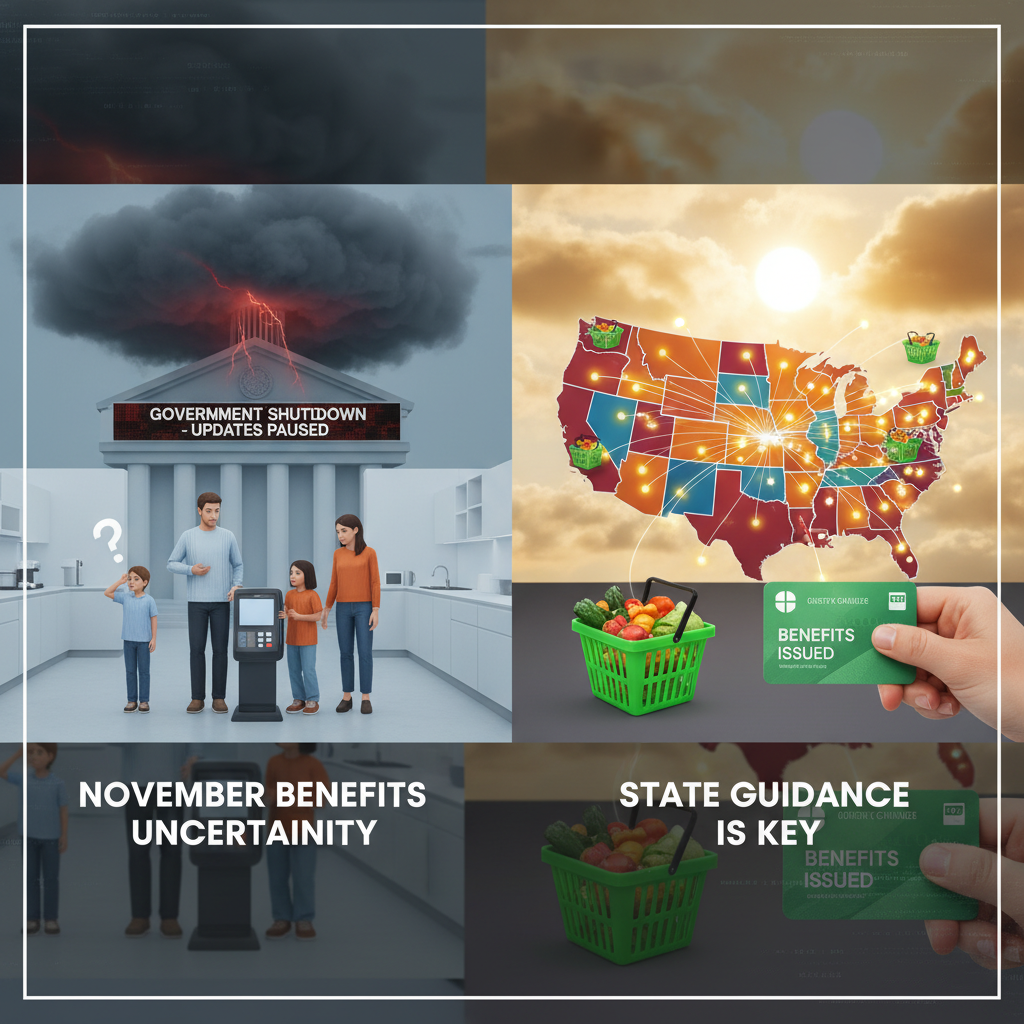
As of today (October 28, 2025), SNAP households and frontline operators are staring at a messy information environment and real uncertainty about November benefits. Here’s our clear, practical read on the situation based strictly on what’s verifiable from federal and state-facing sources—and what you can do next.
The short version
- There is a federal funding lapse/shutdown context affecting USDA/FNS communications. Some FNS pages display politically charged banners indicating a shutdown-related pause in updates. See, for example, the banner text on FNS’s general resources pages here and the FY 2026 COLA landing page here. Treat such banner text as an indicator that official web updates may be delayed, not as a substitute for formal policy guidance.
- The most recent formal issuance guidance FNS provided to state agencies—“SNAP Benefit Issuance and the American Relief Act, 2025”—covered administration and issuance “through the end of April 2025” and was last updated March 12, 2025. See the FNS memo page and policy PDF here.
- We have no newer official USDA/FNS memo in our source set guaranteeing November 2025 issuance. That does not automatically mean benefits will stop; it means there is uncertainty in the absence of up-to-date, formal federal guidance.
- Independent policy analysts at the Center on Budget and Policy Priorities argue the Administration has tools to ensure November issuance during a shutdown. See CBPP’s October 20–21, 2025 analysis (“The Trump Administration Can and Should Take Available Steps to Ensure SNAP Participants Get November Food Benefits”) here.
- At the state level, some officials are publicly warning of risk to November benefits if federal funding isn’t stabilized, and discussing (but not guaranteeing) state stopgaps. For example, the Detroit Free Press reports Michigan is exploring options but calls the scale “a significant amount of money” requiring bipartisan support (article).
Our view: Plan conservatively. Assume variability by state is possible for November and prepare using the steps below. Monitor state agency communications first, given potential delays in federal web updates.
What’s officially on the record
- USDA/FNS directed states to operate “following normal processes and timelines” through April 2025, with administrative expenses funded through that date, in a memo updated March 12, 2025 (FNS policy page; policy memo PDF linked from that page).
- FNS’s SNAP data tables remain accessible, with the latest national/state participation and benefits through May 2025 (FNS data hub). That doesn’t answer the November issuance question but underscores the scale at stake.
- USDA’s Economic Research Service (ERS) reports SNAP averaged 41.7 million participants per month in FY 2024 (down 1% year over year, still above pre-pandemic levels). See ERS’s “Food and Nutrition Assistance Landscape: Fiscal Year 2024” (EIB-291 PDF).
What’s new—and why you’re hearing conflicting claims
- Partisan, politically charged statements appear on several FNS pages in banner-style messages, paired with notices that the website may not be updated during the funding lapse (e.g., “Due to the Radical Left Democrat shutdown…”). See examples on FNS’s Documents & Resources and the SNAP FY 2026 COLA page here.
- Simultaneously, third-party analyses suggest the federal executive branch can take steps to ensure benefits flow in a shutdown. CBPP’s October 2025 post lays out those options (CBPP blog).
- States are signaling risk assessments and contingency exploration. The Detroit Free Press covers Michigan’s discussion of a possible—but uncertain—state bridge (reporting).
Bottom line: There is no single, definitive federal memo in our source set guaranteeing November 2025 SNAP issuance. Some states are preparing for the possibility of federal delays. Expect uneven messaging until federal funding is resolved or new federal guidance is posted.
If you’re a SNAP household: 7 practical steps to take now
-
Check your state’s official portal twice weekly through mid-November.
- States run eligibility and send issuance files. In a shutdown, their updates will be the most timely. Find your state’s SNAP site via the FNS portal and then bookmark it. The federal site’s general resources page is here; navigate to your state from there. -
Keep your EBT card active and protected.
- Do not discard your EBT card. If benefits are issued late, they’ll load to your existing card. If your card is lost, request a replacement from your state agency immediately to avoid delays. -
Map your usual deposit calendar—and plan for variability.
- Many states stagger issuance by case number or last name. In November, be ready for late or partial issuance. Build a minimal bridge plan for 7–10 days if possible. -
Line up backup food resources now.
- Call the USDA National Hunger Hotline at 1-866-3-HUNGRY (English) or 1-877-8-HAMBRE (Spanish) for pantry referrals and meal sites. The hotline is linked from FNS resources, including the SNAP COLA page’s navigation (USDA National Hunger Hotline). -
Save receipts and watch your EBT balance closely.
- Track your balance via your state’s EBT app or phone line. If there’s an issuance glitch, you’ll want clear records. -
Beware misinformation.
- Ignore viral posts that claim universal “no benefits on November 1” without linking to your state’s agency. Given the federal site update constraints, rely on official state channels and reputable policy analysis like CBPP’s SNAP coverage for context. -
If your benefits don’t arrive when expected, contact your state SNAP office the next business day.
- Document the date you expected issuance and any messages you received. Ask whether your case is affected by a federal funding delay or a case-level issue.
If you’re a grocer or authorized retailer: Keep EBT-ready and communicate clearly
- Assume volatility in issuance timing, not a system-wide processor outage.
-
We do not have federal indications that EBT transaction processing will be offline. Prepare for normal transaction acceptance but potentially lower average basket size or delayed traffic.
-
Update front-line staff scripts.
-
Train cashiers to advise customers to check their balance via the state’s EBT line/app and to refer customers to the USDA National Hunger Hotline for emergency food resources (hotline info).
-
Monitor your state agency bulletins.
- If your state announces stagger extensions or temporary issuance shifts, adjust staffing and ordering accordingly.
If you’re a state SNAP leader: What policy signals and data support your planning
- Federal memo coverage ended April 2025.
-
The March 12, 2025 FNS guidance told states to follow normal issuance through April 2025 and confirmed administrative funding through that period (FNS memo page). There’s no newer memo in our sources; that gap is the core issue as November approaches.
-
National scale remains high.
-
ERS reports an average 41.7 million monthly participants in FY 2024 (ERS EIB-291). That magnitude shapes the feasibility of state-only bridges.
-
Public options discourse is active.
-
CBPP’s October 2025 analysis outlines federal administrative options to ensure November issuance despite a shutdown (CBPP blog). While not binding, it’s a useful benchmark for what states should request and plan around.
-
Communications posture matters.
- Given federal website update constraints and visible partisan banners on some FNS pages (example), states should push frequent, neutral, plain-language updates on issuance status and contingency timing.
How to evaluate claims you’re seeing online
- Check the provenance and date.
-
Official federal guidance is generally posted on “.gov” domains. But during a shutdown, federal site updates can be delayed, and banners like those on FNS pages may not constitute formal policy guidance. Verify against your state SNAP agency site.
-
Look for memo artifacts.
-
A genuine issuance directive typically comes as a dated memo to “All SNAP State Agencies” with a PDF and explicit coverage dates (see the January 2, 2025 memo on the FNS policy page). If a post lacks dates, to/subject lines, or PDFs, treat it as commentary.
-
Consider reputable policy intermediaries.
- The Center on Budget and Policy Priorities maintains up-to-date SNAP explainers and timely analysis (SNAP overview; October 2025 shutdown analysis). Use them to contextualize—then confirm at your state site.
Why this matters: the stakes in numbers
- Participation: 41.7 million people on average per month in FY 2024, or roughly 12.3% of U.S. residents, per ERS (EIB-291).
- Spending trend: ERS notes inflation-adjusted SNAP spending fell from FY 2023 to FY 2024 more than any year on record, reflecting the end of pandemic-era boosts (EIB-291 figure notes).
- Data currency: FNS’s published monthly data series extends through May 2025 for participation and benefits at national and state levels (FNS data tables).
These figures underscore why timely, accurate November guidance is essential for households, retailers, and state administrators.
Our take: How to act amid uncertainty
- For households: Build a one-week cushion if you can, line up pantry options, and track your state’s announcements closely. Expect timing variability more than total cancellation unless your state explicitly says otherwise.
- For retailers: Prepare for uneven traffic and questions at checkout. Equip staff with balance-check guidance and hotline referrals. Keep EBT lanes operating normally unless directed otherwise by your processor or state.
- For states: Communicate early and often; publish issuance calendars and any deviations. Engage federal contacts to clarify issuance authorities for November and publicize outcomes quickly. If exploring state bridging, set clear criteria and timelines.
Where to check next
- Your state SNAP agency website and social channels (first stop for issuance timing).
- FNS’s SNAP policy page for any newly posted memos (FNS memo hub example).
- FNS’s data hub for updated participation/benefit figures (SNAP data tables).
- CBPP’s ongoing SNAP policy analysis for context and options (SNAP overview; shutdown/November issuance analysis).
- USDA National Hunger Hotline for immediate food access referrals (hotline).
We will continue to monitor official postings. Until a new federal memo clarifies November issuance, the most reliable guidance will come from your state SNAP agency.