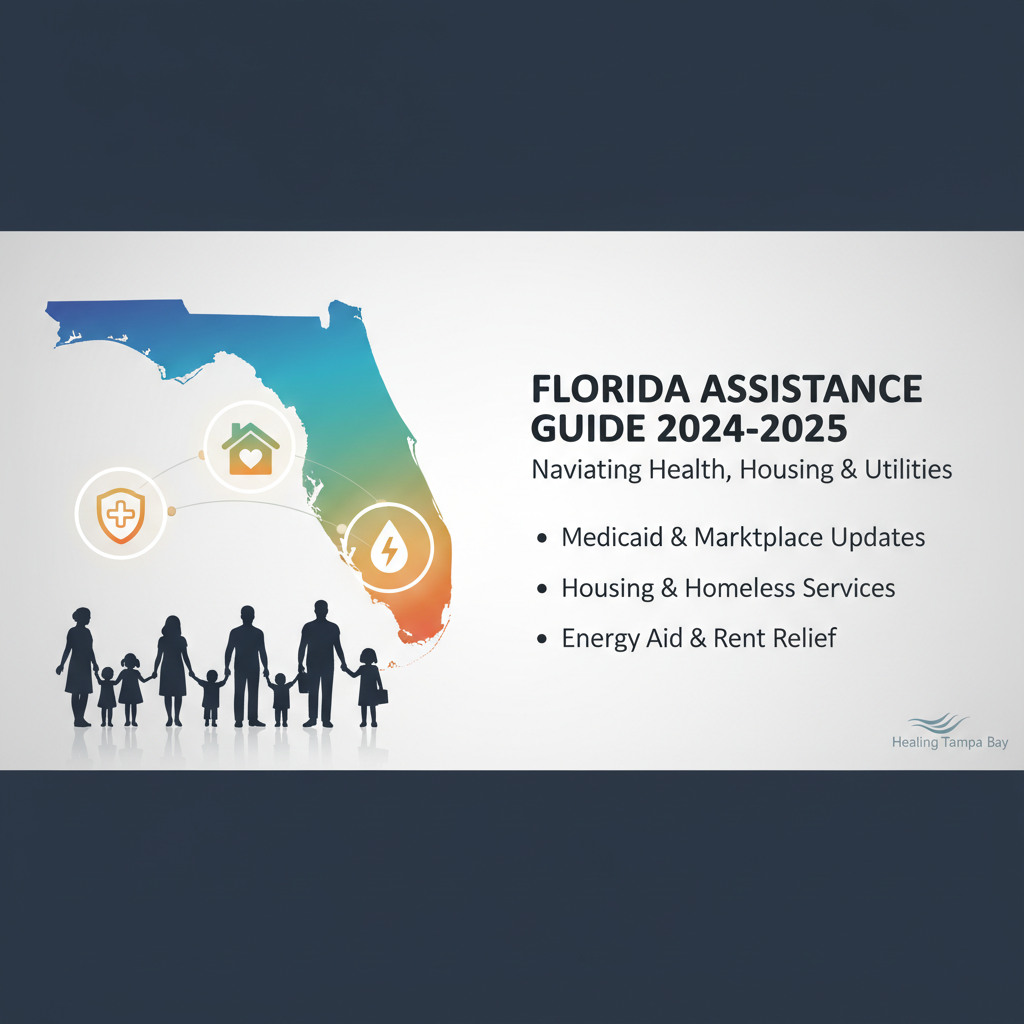
Florida families, seniors, and caregivers are navigating rapid changes across health coverage and basic-needs programs. The last year brought big shifts in Medicaid enrollment, record Marketplace sign-ups, fresh federal energy assistance funds, and continued homelessness and housing investments that affect how and where to seek help.
This guide summarizes notable updates from late 2024 through 2025 and turns them into concrete next steps you can take today. Wherever possible, we include direct links to official agency sources.
The Medicaid landscape in 2025: Fewer adults enrolled, children still a priority
Federal data signal a reset after the pandemic-era continuous coverage rule ended in 2023. The Centers for Medicare & Medicaid Services (CMS) projects that, on a full‑year basis, Medicaid enrollment will average 79.5 million people in FY 2025, down from 96.1 million in FY 2023 as states completed eligibility “unwinding” reviews tied to the end of continuous coverage. Children and adults are both projected to decline modestly from 2024 to 2025 (children from 29.8 million to 28.5 million full‑year equivalents; non‑expansion adults from 17.8 million to 16.5 million; expansion adults from 15.8 million to 14.7 million), according to CMS’ FY 2025 Congressional Justification estimates (CMS budget document, p. 102).
At the same time, CMS highlights that in FY 2022 more than 46.3 million children were enrolled in Medicaid and CHIP combined—over half of all U.S. children—with Medicaid children’s enrollment up 5% over 2021 while CHIP dipped slightly, largely due to policy differences during the pandemic (CMS budget document, pp. 305–306). The 6.2‑percentage‑point federal match increase in the Families First Coronavirus Response Act came with a continuous enrollment condition for Medicaid from January 1, 2020 through March 31, 2023; that protection did not apply to CHIP in most states, which helps explain why more children remained on Medicaid than CHIP during that period (CMS budget document).
What this means for Florida families:
- Many adults lost or will lose Medicaid in the 2024–2025 period due to unwinding reviews.
- Children often still qualify even when parents do not. If your child lost coverage, review your eligibility again—especially if your income, household size, or address changed.
If you lost Medicaid: Act quickly and consider the ACA Marketplace fallback
Marketplace plans have become a crucial safety net for people leaving Medicaid. CMS reports that 24.2 million consumers selected Affordable Care Act (ACA) Marketplace coverage for 2025, including 3.9 million new enrollees—more than double the number compared to 2021, reflecting a strong “fallback” option for people exiting Medicaid (CMS enrollment snapshot press release).
Your action plan:
1. Respond immediately to any Medicaid redetermination mail or texts. If Florida Medicaid asked for documents, meet the deadline and confirm your address and phone number are up to date with the state.
2. Re‑check children’s eligibility. CMS stresses that children’s Medicaid/CHIP coverage is a cornerstone of national child health coverage (CMS budget document).
3. If you’re no longer eligible, use a Special Enrollment Period (SEP) to move to the Marketplace. Losing Medicaid triggers an SEP; do not wait until next Open Enrollment. Marketplace plans vary in premium and cost sharing based on income, household size, and county. Use Healthcare.gov to compare options; record enrollments for 2025 have made subsidized plans widely accessible (CMS enrollment snapshot press release).
4. Keep documentation organized. Common proofs include ID, income (pay stubs or award letters), and household size.
Tip: If premium costs are an issue, look at Silver-level plans if you qualify for cost-sharing reductions; these can lower deductibles and copays substantially for eligible incomes. If your income changes mid‑year, report it; you may re‑qualify for Medicaid or for bigger Marketplace subsidies.
Homeless services and housing investments: What’s new and how to access help
HUD reports sustained funding to reduce homelessness and improve the homelessness response system:
- In FY 2023, HUD awarded $2.8 billion in Continuum of Care (CoC) grants to local homeless services and housing programs across the U.S., including over $52 million for projects serving survivors of domestic violence, plus about $80 million for Youth Homelessness Demonstration Program (YHDP) renewals (HUD FY 2025 Annual Performance Plan & FY 2023 APR, pp. 39–41).
- In April 2023, HUD announced $486 million in unsheltered and rural homelessness grants and $43 million in Stability Vouchers as part of a first‑of‑its‑kind initiative targeting people living in unsheltered settings and rural areas (HUD FY 2025 APP & FY 2023 APR, p. 39).
- In June 2024, HUD awarded $26 million through HOPWA Housing Interventions (HINT) to align housing with efforts to end the HIV epidemic, and released a $72 million YHDP funding opportunity to support youth rapid rehousing, permanent supportive housing, transitional housing, host homes, and wrap‑around services (HUD FY 2024 Agency Financial Report, pp. 12–13).
- HUD’s target is to reduce unsheltered homelessness by 7% from 2023 levels by September 30, 2025. The agency notes that unsheltered homelessness has risen by an average of 6% per year since 2015, underscoring the need for coordinated efforts (HUD FY 2024 AFR, p. 12; HUD FY 2025 APP & FY 2023 APR, pp. 40–45).
How to connect with services in Tampa Bay:
- Start with your local Continuum of Care (CoC). CoCs manage Coordinated Entry, which is the front door for housing assessments and referrals to shelter, rapid rehousing, permanent supportive housing, and targeted projects for youth and survivors of domestic violence. HUD’s performance plan emphasizes improvements to Coordinated Entry and equity-focused approaches (HUD FY 2025 APP & FY 2023 APR, pp. 40–45).
- If you or a family member is living with HIV, ask about HOPWA-funded resources locally; HOPWA grants support housing and can prevent homelessness among people with HIV (HUD FY 2024 AFR).
- If a disaster disrupted your housing, ask local providers about any time-limited Rapid Unsheltered Housing (RUSH) resources; HUD used RUSH for Maui post‑wildfires, a model that may inform future disaster responses (HUD FY 2025 APP & FY 2023 APR, p. 41).
Practical tips:
- Be ready to complete a Coordinated Entry assessment. Share safety needs, disabilities, chronic homelessness history, and veteran status; this helps match you to the right program.
- If you are fleeing domestic or sexual violence, ask to be connected to victim services projects funded under CoC or specialized programs. You have the right to private, trauma-informed support.
Utilities assistance: New LIHEAP funds for FY 2025—apply early
Energy bills strain tight budgets, especially for seniors and families with young children. The Low Income Home Energy Assistance Program (LIHEAP) helps with heating/cooling bills and, in some cases, crisis energy needs and weatherization. On October 31, 2024, the U.S. Administration for Children and Families (ACF) announced the release of $3.7 billion for FY 2025 LIHEAP—about $3.6 billion in regular block grants plus an additional $100.108 million—funded under the Continuing Appropriations and Extensions Act, 2025 (ACF Dear Colleague Letter).
Your steps:
- Apply as soon as your local LIHEAP program opens or reopens. Funding is limited and often distributed on a first-come, first-served basis through local agencies.
- Gather documents: ID, Social Security numbers (if available), proof of residence, current utility bills, proof of income for all household members, and information on at‑risk seniors, young children, or medical conditions worsened by heat/cold.
- Ask about crisis assistance if you have a shutoff notice. Some LIHEAP administrators can expedite help in medical or life‑threatening situations.
Note: Eligibility thresholds and benefit amounts vary by state and county. LIHEAP is administered locally; check your county community action agency or energy assistance office for application windows and priority criteria. The national funding update is here: ACF LIHEAP funding release.
Rental assistance and eviction prevention: Where ERA stands in 2025
The Treasury Emergency Rental Assistance (ERA) program delivered substantial help during the pandemic, and some communities still administer remaining ERA2 funds. Treasury has continued to issue compliance and flexibility guidance:
- On March 5, 2024, Treasury clarified that ERA2 funds can cover costs for acquisition of real property and predevelopment activities to build, rehabilitate, or preserve affordable rental housing serving very low‑income families—aimed at longer‑term stabilization (Treasury ERA guidance page).
- On October 4, 2024, Treasury and its Office of Inspector General reminded grantees of responsibilities for using ERA funds, signaling continued oversight as funds wind down (Treasury ERA guidance page).
- On August 13, 2025, Treasury notified ERA2 grantees it would apply certain provisions of the 2024 revised Uniform Guidance to ERA2 awards (Treasury ERA guidance page).
What to do now:
- Check whether your county or city still has ERA or similar local rent/utility arrears funds. Availability varies; some programs have closed while others operate with remaining ERA2 or local dollars.
- Document hardship: past-due rent, utility arrears, income loss, and any eviction filings or notices.
- Contact your landlord early. Many assistance programs require landlord participation or will ask for a ledger and W‑9.
- Combine resources: If ERA is not available, ask about local homelessness prevention funds, legal aid for eviction defense, and utility relief via LIHEAP.
For people experiencing homelessness: Medicaid can help stabilize health—and sometimes housing-related supports
State Medicaid programs cannot pay rent, but they can fund certain housing-related services that improve health outcomes and housing stability. The AMA Journal of Ethics explains that CMS’ 2015 guidance allows states, through waivers, to cover services such as help preparing for and transitioning to housing, identifying and securing housing options, tenancy support, behavioral health and substance use treatment, and some transportation—supports that are particularly important for people experiencing homelessness (AMA Journal of Ethics overview).
Key takeaways from the AMA Journal of Ethics discussion:
- Many Medicaid-eligible adults experiencing homelessness are not enrolled; one multi‑city study found nearly 75% of eligible chronically homeless adults were not enrolled at the time of the study, underscoring the need for targeted outreach and simplified enrollment support (AMA Journal of Ethics).
- Linking Medicaid-covered services with supportive housing programs can reduce avoidable hospital use and improve health, which benefits patients and the safety net.
Your actions:
- If you are unsheltered or in temporary shelter, apply for Medicaid or re‑apply if you were disenrolled. Even without a fixed address, you can designate a mailing address with a service provider. Coverage can open doors to mental health care, substance use treatment, and care coordination—services that can be paired with housing programs.
- Tell your health care provider or case manager you want help with housing-related needs; ask whether they can connect you to tenancy support, care management, or other services covered under state Medicaid options.
How these updates fit together—and how to prioritize next steps
- If you lost Medicaid or expect to: confirm eligibility and respond to notices immediately. If ineligible, shift to a Marketplace plan using your Special Enrollment Period. Record Marketplace uptake is high, which may reflect broader access to affordable options in 2025 (CMS press release).
- If you are behind on utilities: apply to LIHEAP now that FY 2025 funds have been released nationally (ACF LIHEAP announcement). Ask about crisis criteria and weather-related priorities.
- If you are at risk of eviction or currently homeless: connect to your local CoC’s Coordinated Entry for housing assessments and referrals. HUD’s current funding emphasizes unsheltered, rural, youth, and survivors of violence, along with HOPWA supports for people with HIV (HUD FY 2025 APP & FY 2023 APR; HUD FY 2024 AFR).
- If local rental aid seems limited: some jurisdictions are repurposing ERA2 toward long‑term affordable housing supply and predevelopment under Treasury guidance, which may reduce short‑term cash assistance but can expand units serving very low‑income tenants over time (Treasury ERA guidance). Ask local housing agencies about any open tenant-based prevention funds as well as waitlists for long-term vouchers.
Where Healing Tampa Bay fits in
Healing Tampa Bay’s outreach team focuses on helping our neighbors enroll in and navigate:
- Medicaid, CHIP for kids, and Marketplace plans
- Utilities assistance applications like LIHEAP
- Homeless services access through Coordinated Entry
- Housing-related programs we track locally
We can help you:
- Screen your eligibility and prepare documents for Medicaid redeterminations or Marketplace enrollment.
- Identify the right LIHEAP intake site and what to bring.
- Connect with the local homelessness system, including youth and survivor-focused options, and HIV-related housing supports under HOPWA where applicable.
- Understand timelines and realistic next steps if you are facing eviction.
Bottom line
- Medicaid enrollment is recalibrating after the end of continuous coverage, with CMS projecting 79.5 million full‑year equivalents in 2025 and notable declines among adults relative to 2023 levels (CMS budget document).
- Children remain a core focus; if your child lost coverage, re‑check quickly—kids’ eligibility thresholds are often higher than for adults (CMS budget document).
- Marketplace enrollment reached 24.2 million for 2025, including 3.9 million new consumers, offering a strong fallback for those leaving Medicaid (CMS press release).
- LIHEAP distributed $3.7 billion for FY 2025. Apply early with complete documentation to maximize your chance of assistance (ACF LIHEAP announcement).
- HUD continues to fund homelessness responses across CoC, unsheltered/rural initiatives, youth programs, and HOPWA, with a goal to reduce unsheltered homelessness by 7% by September 2025 (HUD FY 2025 APP & FY 2023 APR; HUD FY 2024 AFR).
- ERA2 remains under federal oversight; recent guidance enables some funds to support development or preservation of affordable rentals for very low‑income families. Local availability of direct rental aid varies widely (Treasury ERA guidance).
If you’re unsure where to begin, start with one concrete step that matches your most urgent need—health coverage, utilities, or housing—and reach out for help. Healing Tampa Bay’s team will work with you to build a plan, submit accurate applications, and connect you to the right local partners using the most current federal guidance and funding streams cited above.