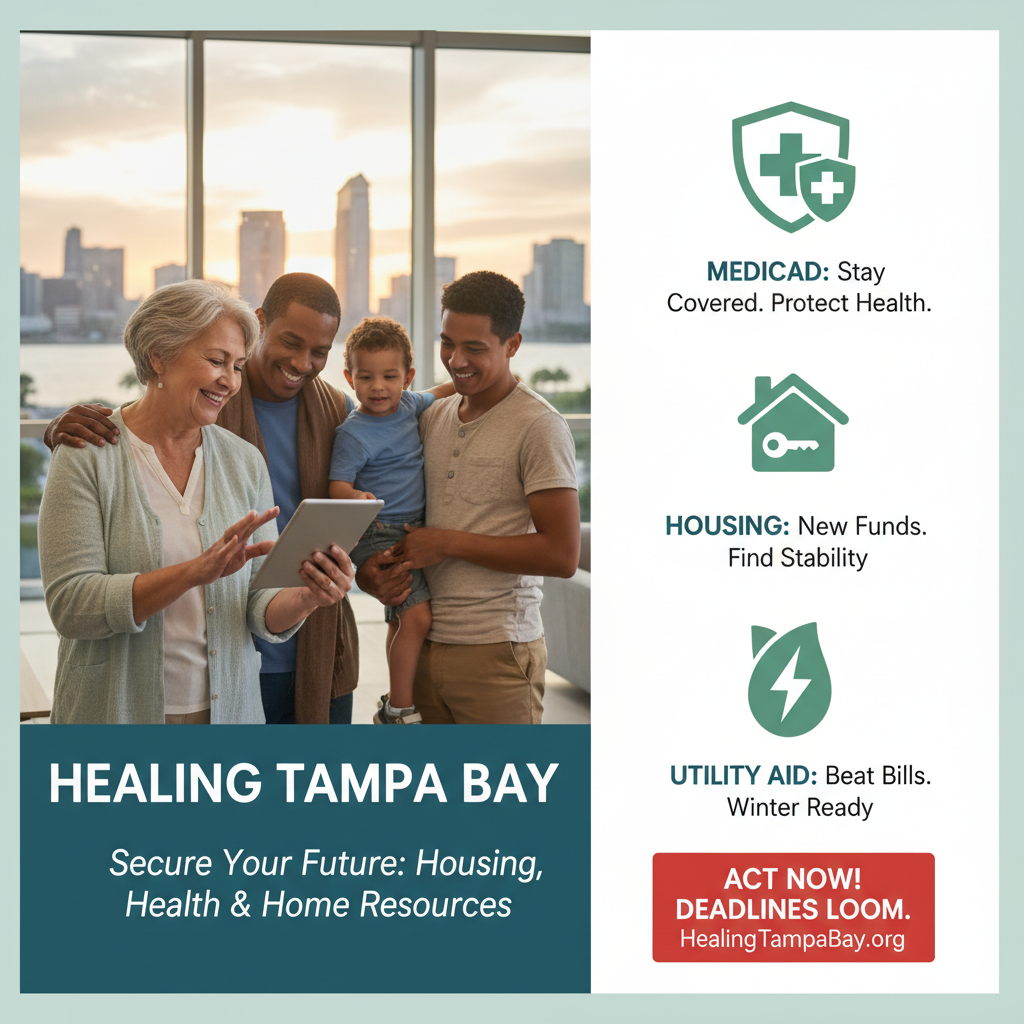
If you’re a senior, a caregiver, or a family living on a tight budget in the Tampa Bay area, the last few months have brought real changes—and real opportunities—across Medicaid, homeless services, housing assistance, and utility help. At Healing Tampa Bay, we help neighbors navigate these programs every day. Our message right now is simple and urgent: this is a window to get covered, stabilize housing, and reduce your bills before the winter energy season and the end‑of‑year crunch.
Here’s what’s changed, why it matters, and the exact steps to take—backed by current data and official notices.
What’s happening with Medicaid enrollment—and why it matters for housing stability
-
Medicaid disenrollments continue after the end of the “continuous coverage” policy from the pandemic era. During the three years of continuous enrollment, states paused Medicaid disenrollments. When that policy ended in March 2023, states restarted renewals and closures. The latest national view is captured in KFF’s Medicaid Enrollment and Unwinding Tracker, updated September 30, 2025, which compiles monthly state enrollment data and archived renewal outcomes from CMS and states. See the live tracker here: KFF’s Medicaid Enrollment and Unwinding Tracker.
-
Why this is a housing issue: Medicaid is a backbone for health and housing stability, especially for people facing or exiting homelessness. According to the National Alliance to End Homelessness, Medicaid supports key “housing-adjacent” services through state options like 1115 waivers, 1915(i), and “in lieu of services.” These can include tenancy supports, housing navigation, and limited rental assistance—precisely the services that help someone keep a roof over their head. The Alliance warns that cutting Medicaid would increase homelessness, especially in rural communities where clinics rely on Medicaid funding.
-
The research context is clear: stronger Medicaid access improves health and housing outcomes among people experiencing homelessness. Peer‑reviewed analysis of expansion and implementation challenges underscores how coverage barriers keep many chronically homeless people “technically eligible, practically ineligible,” reinforcing the need for hands-on navigation and flexible enrollment supports (NIH’s PMC analysis).
Practical steps for Medicaid right now
- If you lost coverage during the unwinding or were told to reapply:
- Respond quickly to any renewal notices and requests for documents.
- Make sure your mailing address, email, and phone number are current with your state Medicaid office—KFF’s tracker notes that outdated contact info has been a major cause of procedural terminations (KFF tracker).
- Gather documents proactively: proof of identity, household size, income, and immigration status, if applicable.
- If your medical situation has worsened, ask whether you may qualify under disability‑related pathways.
- If you disagree with a decision, request an appeal or fair hearing promptly; deadlines are strict.
-
If you are experiencing or at imminent risk of homelessness, tell the eligibility worker (some states can expedite or coordinate with housing/homeless-service providers).
-
If you are housing-unstable, ask about supports Medicaid can cover in your state: tenancy supports, case management, and care coordination—services often funded through the Medicaid authorities cited by the National Alliance (Alliance analysis).
-
For caregivers and seniors: if you help someone who moves frequently, consider listing a trusted mailing address where notices won’t be missed (with permission). Many disenrollments have been procedural rather than due to true ineligibility, per the ongoing monitoring summarized in KFF’s tracker.
Housing assistance: What 2025 funding signals mean for Tampa Bay renters and veterans
-
More funding for homelessness response. The FY 2025 President’s Budget requests $4.1 billion for HUD Homeless Assistance Grants (HAG)—about $427 million more than the prior annualized level. HUD notes homelessness fell 9% from 2010–2022 but rose 12% in 2023, and HAG funds are central to reversing that trend with prevention, shelter, rapid re-housing, transitional housing, and permanent supportive housing (HUD Budget in Brief, FY25).
-
Vouchers: updates and opportunities. HUD’s May guidance implements 2025 funding provisions for the Housing Choice Voucher (HCV) program (Notice PIH 2025‑13). According to the National Association of Housing and Redevelopment Officials, the notice updates how Public Housing Agencies (PHAs) manage reserves and clarifies the structure of housing assistance and administrative payments (NAHRO’s summary). For residents, the bottom line is: watch for waitlist openings and be ready with documents and a stable contact method.
-
Veterans: new VASH vouchers. HUD opened a 2025 “Registration of Interest” for approximately $34 million in Veterans Affairs Supportive Housing (VASH) funding—supporting roughly 3,400 new vouchers (PHADA breaking news). If you are a veteran experiencing homelessness or housing instability, ask your local VA and housing authority about VASH eligibility and referrals.
-
SAMHSA and homelessness services: targeting high‑need populations. The FY 2025 budget supports 47 continuation grants and five new awards through the Projects for Assistance in Transition from Homelessness (TIEH) and related contracts to scale evidence‑based, integrated care (including the Housing and Homeless Resource Center and SOAR). The latest federal count underscores the need: on a single night in January 2023, 653,104 people experienced homelessness; 154,313 were chronically homeless; 137,076 had severe mental illness; 108,035 were affected by chronic substance use; and 35,574 were veterans (SAMHSA FY25 Congressional Justification). The U.S. Interagency Council on Homelessness is working toward a 25% reduction goal by January 2025, focused on equity, data, and collaboration (SAMHSA CJ).
-
What these housing updates mean for Tampa Bay residents:
- Be alert for local HCV and project‑based voucher waitlist openings. Funding and policy updates often ripple into periodic openings—being ready gives you an edge.
- Veterans should connect with VA case managers about VASH referrals now, given the 2025 funding queue (PHADA update).
- If you’re in a homeless response program (shelter, outreach, or rapid rehousing), ask staff whether your services are supported by HUD HAG or ESG funds and what that means for rental assistance length, documentation, and case management. ESG programs specifically fund outreach, shelter, rapid rehousing, and prevention (LA ESG program description – illustrative of ESG uses). Even though that document is about a California jurisdiction, the funding categories and service types reflect the federal program design in communities nationwide.
Utility assistance: 2025 LIHEAP dollars are flowing—apply early before winter bills spike
-
The federal Low Income Home Energy Assistance Program (LIHEAP) helps with heating and cooling bills and crisis energy needs. For FY 2025, HHS released a first tranche of $3.7 billion on October 31, 2024, followed by a final release of about $401.5 million on May 1, 2025 (ACF LIHEAP First Release; ACF LIHEAP Final Release).
-
What that means for your household:
- Funds are allocated to states, territories, and tribes—then administered locally. The earlier you apply, the better your chances before funds are committed.
- Have ready: proof of household income, recent energy bills, ID, and documentation of a heating or cooling emergency if you have one.
- If you use delivered fuels (propane, fuel oil), ask about vendor participation and scheduling as early as possible.
-
If you or a loved one is medically vulnerable, ask whether your local administrator offers crisis prioritization or medically necessary cooling assistance.
-
Pair LIHEAP with energy budgeting strategies:
- Enroll in utility budget billing or payment plans if available.
- Ask about weatherization referrals when you apply (some agencies coordinate LIHEAP with energy efficiency services).
- If you’re a renter, request a landlord’s consent for basic weatherization measures that can reduce bills.
Homeless services: how federal funding is being applied on the ground
-
HUD’s Homeless Assistance Grants (HAG) support Continuums of Care and Emergency Solutions Grants (ESG) that fund outreach, shelter, rapid rehousing, prevention, and permanent supportive housing. HUD emphasizes that coordination with health systems—especially since COVID‑19—is critical to reduce unsheltered homelessness (HUD Budget in Brief, FY25).
-
SAMHSA’s FY 2025 plan maintains investment in TIEH continuation grants and adds a new cohort—aimed at expanding capacity for integrated, evidence‑based treatment and housing supports, including SOAR assistance to accelerate SSI/SSDI access for people who are homeless (SAMHSA FY25 CJ).
-
For families and seniors:
- If you are in shelter or working with a case manager, ask if your program can help with SSI/SSDI applications via SOAR, or connect you to behavioral health services—all of which can improve housing stability and financial eligibility for rent subsidies.
- If you’re unsheltered, ask local outreach teams about immediate shelter options, rapid rehousing assessments, and documentation clinics (ID, Social Security card, and birth certificate replacements are often the biggest bottlenecks to housing).
The through‑line: coverage + services + rent support = stability
The data and funding decisions this year all point in the same direction: when people have health coverage (Medicaid), housing support (vouchers, HAG‑funded rehousing), and help with basic costs (LIHEAP), households stay stable. Conversely, losing coverage or missing one portal deadline can start a domino effect of unpaid bills, untreated illness, or eviction risk. The National Alliance to End Homelessness is blunt: Medicaid cuts would increase homelessness—and the reverse is also true: strong enrollment and benefit navigation reduce it.
How Healing Tampa Bay can help you use this moment
We’re a community nonprofit that helps Florida residents enroll in Medicaid, Marketplace plans, SNAP, and other supports—fast. We also coordinate with local housing and homeless-service providers. Here’s how we put today’s updates to work for you:
- Medicaid “re‑entry” strategy:
- We help you update contact info, upload documents, and track deadlines tied to the ongoing unwinding highlighted by KFF’s tracker.
-
If you’re in a homeless-services program, we coordinate with your case manager to align Medicaid-covered supports (tenancy services, care coordination) as emphasized by the National Alliance’s analysis.
-
Housing readiness:
- We prep document packets for voucher waitlists and rapid rehousing referrals—so when a list opens or a referral is made, you’re first in line.
-
Veterans: we’ll help you connect with VA and your housing authority to pursue VASH now, given HUD’s 2025 funding notice for roughly 3,400 new vouchers (PHADA news).
-
Utilities relief:
- We assemble LIHEAP applications with the right proof and help you request crisis help, leveraging the 2025 federal releases documented by HHS (ACF first release; ACF final release).
Our viewpoint, informed by the latest policy: act early and stack benefits
Based on current federal updates and sector analysis, our stance is clear:
- Act early: Benefits are first‑come, first‑served in practice—even when entitlement rules say otherwise. Early applications and complete documents dramatically improve outcomes.
- Stack benefits: Pair Medicaid with housing supports and LIHEAP. This “bra