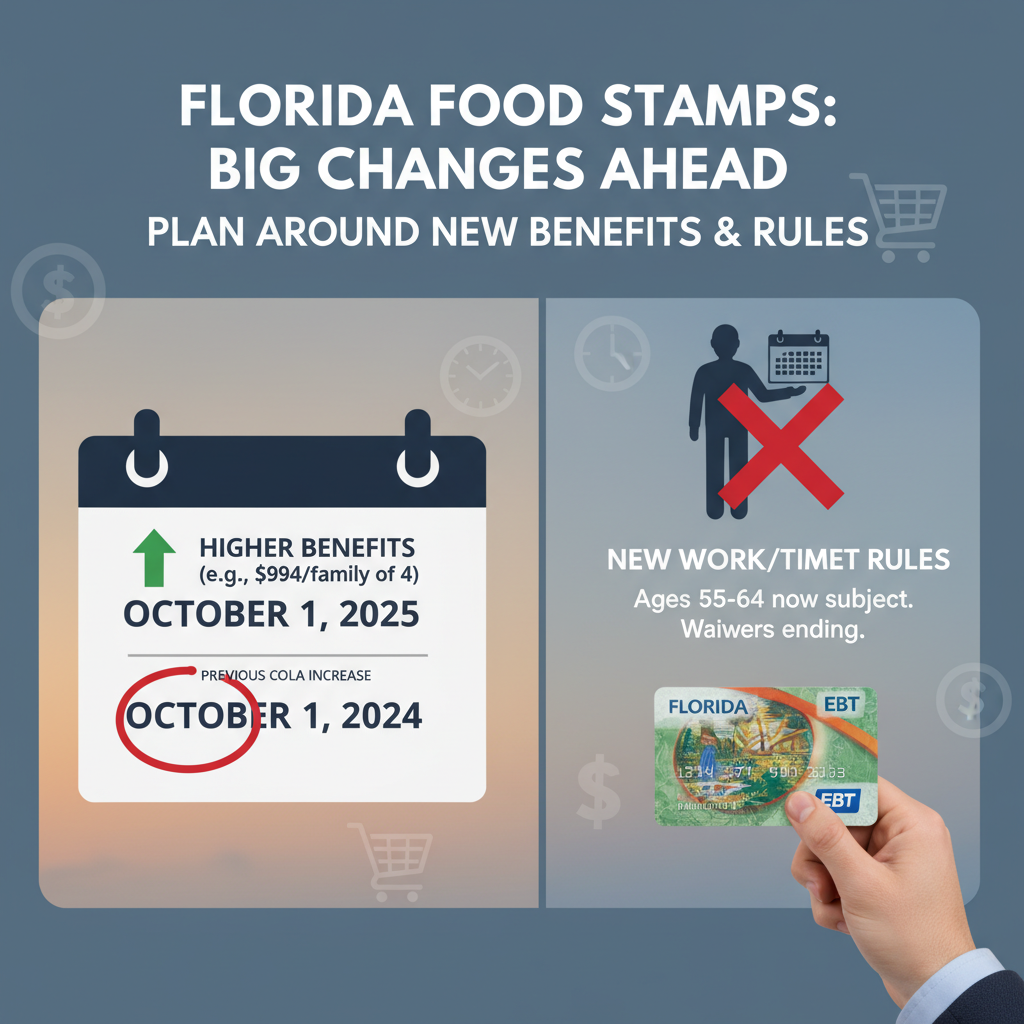
If you use SNAP (Food Stamps) or help someone who does in Florida, there are two big developments to plan around this year: higher benefit amounts starting October 1, 2025, and new work/time‑limit rules for many adults without dependents, with earlier changes already in effect since October 1, 2024. Below is a clear, action‑oriented guide to what’s changing, who’s affected, and how to protect your benefits.
What’s changing with SNAP benefits on October 1, 2025
-
SNAP maximum benefit amounts are going up again. The U.S. Department of Agriculture’s Food and Nutrition Service (FNS) updates SNAP each federal fiscal year through a cost‑of‑living adjustment (COLA) based on food price changes. According to the FNS FY 2026 update, effective Oct. 1, 2025, the maximum monthly allotment for a family of four in the 48 states and D.C. (which includes Florida) will be $994. FNS notes that maximum allotments will also increase in Alaska, Guam, and the U.S. Virgin Islands, with higher ranges in those locations due to higher food costs. See the FY 2026 COLA overview and memo from FNS for details: SNAP FY 2026 Cost‑of‑Living Adjustments.
-
Income eligibility standards and certain deductions are also adjusted each year. FNS emphasizes that maximum allotments, deductions, and income eligibility standards are recalculated at the start of every federal fiscal year (Oct. 1) to reflect the cost of living. This means some households who were just over the limit before may become eligible after an annual update, and some current households may see benefit amounts change. Learn more on FNS’s overview page: SNAP Cost‑of‑Living Adjustment (COLA) Information.
-
This year’s increase follows last year’s bump. FNS previously announced the FY 2025 COLA effective Oct. 1, 2024; that update also raised maximum allotments and updated eligibility standards. See the FY 2025 notice to state agencies: SNAP – Fiscal Year 2025 COLA.
What this means for a Florida household
-
Florida follows the 48‑state standard for SNAP maximums. The $994 maximum for a family of four is the federal cap for states like Florida. Your actual benefit depends on household size, countable income, allowable deductions, and other federal SNAP rules that the state administers.
-
You may see a new benefit amount on or after Oct. 1, 2025. The state agency applies COLA changes automatically at recertification or when FNS directs states to mass‑update budgets at the start of the fiscal year. If your October benefit looks different, the COLA is a likely reason.
-
If you were previously denied for being just over the income limit, consider reapplying after Oct. 1. FNS confirms that income eligibility standards are updated annually with COLA. Even small adjustments can matter for households near the margin. See the FNS COLA overview here: SNAP Cost‑of‑Living Adjustment (COLA) Information.
New work/time‑limit rules for Able‑Bodied Adults Without Dependents (ABAWDs)
Congress passed new SNAP provisions as part of the One Big Beautiful Bill Act of 2025 (OBBB), signed July 4, 2025. FNS issued implementation memoranda this fall. Two developments matter most:
1) Adults ages 55–64 may now be subject to the ABAWD time limit
-
FNS directs states to update notices to ensure individuals aged 55 to 64 are properly notified that they are now subject to the ABAWD time limit. See FNS’s implementation guidance: ABAWD Exceptions – Implementation Memorandum.
-
The ABAWD rule generally limits SNAP to three months in a 36‑month period for adults subject to it unless they meet work requirements or qualify for an exemption. Under OBBB, the age range covered by the time limit expands to include many 55–64‑year‑olds. Florida households with adults in this age range should carefully read any notices and review the exemptions list in the state’s materials.
-
FNS emphasizes that state agencies must provide consolidated written notice and an oral explanation of all applicable work requirements, including the general work requirements, ABAWD time limit, and any mandatory SNAP Employment & Training (E&T) assignment. Source: ABAWD Exceptions – Implementation Memorandum.
2) ABAWD waivers are being curtailed and terminated
-
FNS is strongly encouraging states to terminate active ABAWD waivers that were previously approved under “lack of sufficient jobs” criteria. In fact, FNS states it will terminate any such waivers 30 days after issuing its memorandum, and areas with waivers expiring on or before Nov. 2, 2025 do not need additional action to terminate. That means many areas that previously paused the ABAWD time limit will need to enforce it again. See FNS’s waiver guidance: ABAWD Waivers – Implementation Memorandum.
-
Before terminating waivers, FNS expects states to prepare to enforce the time limit by updating eligibility systems, notifying affected households, and training workers. If you relied on a local waiver, plan for the possibility that the time limit may now apply. Source: ABAWD Waivers – Implementation Memorandum.
-
Special provisions for Alaska and Hawaii do not affect Florida. OBBB establishes special waiver criteria and a new exemption type tied to unemployment rates in Alaska and Hawaii; these special rules are not applicable to Florida. Source: ABAWD Waivers – Implementation Memorandum.
Important procedural notes from FNS for households and helpers
-
Expect consolidated notices and explanations of work rules. FNS requires states to provide households with a combined written notice and oral explanation of all applicable work requirements and time limits. Take time to read these carefully and ask questions promptly. Source: ABAWD Exceptions – Implementation Memorandum.
-
Verification still matters. FNS reminds states to follow standard verification rules for exemptions and compliance. Practically, that means keep documentation organized (work hours, public service participation, medical documentation for exemptions, etc.). Source: ABAWD Exceptions – Implementation Memorandum.
-
States have a 120‑day “hold harmless” in federal Quality Control after implementation dates, but that does not waive household requirements. FNS may exclude variances for up to 120 days for QC purposes, but that protection is about state error measurement—it does not change your obligation to comply with the rules or deadlines. Source: ABAWD Exceptions – Implementation Memorandum.
What Florida SNAP recipients and caregivers should do now
1) Watch your mail and messages closely through the fall. FNS explicitly instructs states to notify households of ABAWD changes and the end of certain waivers. If you or someone you help may be affected, read every notice and act by the stated deadlines. See: ABAWD Waivers – Implementation Memorandum and ABAWD Exceptions – Implementation Memorandum.
2) If you are 55–64 and live alone or without dependents, check if you’re now considered an ABAWD. OBBB expanded who is subject to the time limit. If you become subject, you’ll typically need to meet defined work or qualifying activity requirements to keep receiving SNAP beyond the three‑month limit in a 36‑month period unless you qualify for an exemption. Source: ABAWD Exceptions – Implementation Memorandum.
3) If your area previously had an ABAWD waiver, prepare as if that waiver will end. FNS is terminating outdated waivers and “strongly encourages” full implementation of work requirements going forward. Plan ahead to avoid interruptions. Source: ABAWD Waivers – Implementation Memorandum.
4) Keep records. If you are subject to work/time‑limit rules, maintain documentation of qualifying hours or activities, and any factors that may qualify you for an exemption. FNS directs states to follow verification rules—good records are your best protection. Source: ABAWD Exceptions – Implementation Memorandum.
5) Consider reapplying or updating your case after Oct. 1, 2025 if you were just over the income limit or saw a lower benefit. Because COLA updates income thresholds and deductions annually, a small change could make a household newly eligible or increase benefits. See FNS’s COLA overview and the FY 2026 memo: SNAP FY 2026 COLA.
6) Understand how and when you get benefits. Since 2004, SNAP has used Electronic Benefits Transfer (EBT) to load monthly benefits that you spend like a debit card at authorized retailers. USAFacts, citing USDA data, notes EBT is how benefits are paid monthly nationwide. See: USAFacts on SNAP spending and delivery.
What this means for budgets and expectations
-
Average per‑person benefits have come down from pandemic highs, but annual COLAs continue to adjust for food costs. USAFacts reports that in FY 2024 the average participant received $188 per month, down from a FY 2021 high of $253 per person after temporary pandemic boosts ended, while total federal spending fell to $100.3 billion in FY 2024 from the inflation‑adjusted $132.2 billion in FY 2021. Those figures help explain why some households felt reductions in recent years even as prices rose, and why the annual COLA updates matter. Source: USAFacts on SNAP spending and trends.
-
The bottom line for Florida households: the Oct. 1, 2025 COLA is designed to partially keep pace with food inflation, and the updated income standards may widen eligibility at the margins. At the same time, the new ABAWD rules will narrow continuous eligibility for certain adults unless they meet work or exemption criteria. Planning ahead is essential.
If you’re a senior or caregiver in Florida
-
Seniors 60+ who rely on SNAP should pay special attention if they are ages 60–64 and do not live with a dependent. FNS’s memo clarifies that individuals aged 55–64 must be notified that they are now subject to the ABAWD time limit if they meet other criteria. If that’s you or someone you help, be ready to review exemptions and respond to state notices. See: ABAWD Exceptions – Implementation Memorandum.
-
For caregivers assisting adult children or relatives: watch for waiver terminations. If your loved one’s county previously had a waiver of the ABAWD time limit, FNS guidance indicates many such waivers are ending or being terminated by FNS. Make a plan now to document qualifying work or activities if needed. Source: ABAWD Waivers – Implementation Memorandum.
Key dates to circle
- Oct. 1, 2024: FY 2025 COLA took effect (benefits and eligibility standards adjusted). Source: [FY 2025 COLA memo](https