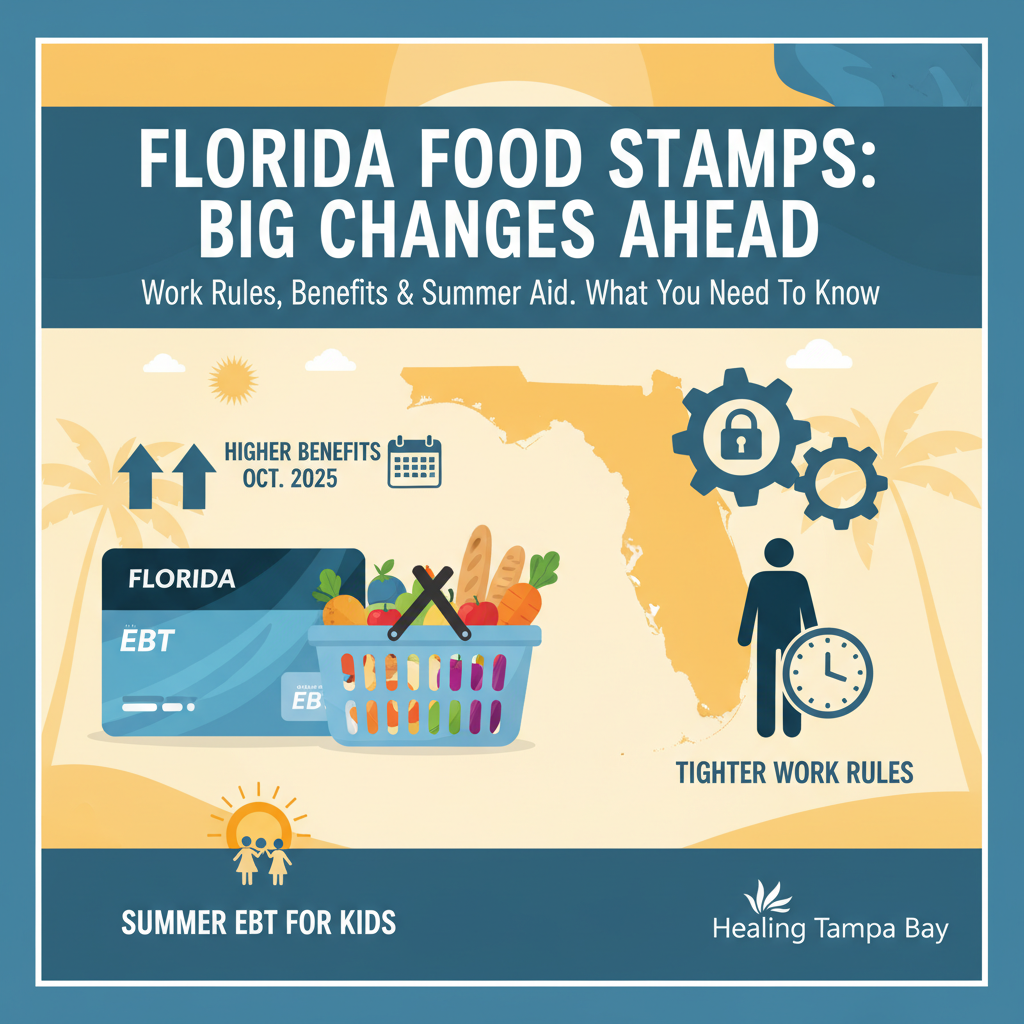
If you rely on SNAP (food stamps) or your family uses EBT benefits in Florida, there are two big developments affecting many households right now: stricter enforcement of work rules for certain adults and higher benefit maximums due to the new federal cost-of-living adjustment. There’s also continuing news on Summer EBT for kids. Here’s what Florida seniors, low‑income families, and caregivers need to know—and the steps to take now to avoid gaps in benefits.
1) Work rules for some adults are tightening as USDA moves to end most area waivers
The USDA’s Food and Nutrition Service (FNS) released an implementation memo tied to the One Big Beautiful Bill Act of 2025 (OBBB) directing states to end most existing waivers of the so‑called ABAWD time limit, which applies to “able-bodied adults without dependents.” According to the memo, FNS will terminate any active ABAWD waivers approved under the older “lack of sufficient jobs” criterion 30 days after the memo’s release, and it “strongly encourages State agencies to fully implement the work requirements and not seek waivers” going forward. The memo also notes that new waivers cannot run longer than 12 months and will be evaluated against updated criteria and federal labor data, typically from the Bureau of Labor Statistics. See the USDA’s guidance: Supplemental Nutrition Assistance Program Provisions of the One Big Beautiful Bill Act of 2025 – ABAWD Waivers – Implementation Memorandum.
What this means for Florida households:
- Expect more areas of Florida to be subject to the ABAWD time limit again. FNS explicitly directs states to prepare for enforcement by updating eligibility systems, notifying households, and training workers before ending waivers. Households should watch mail, text, or online account notices closely because local enforcement can restart quickly after waiver termination, per the federal memo.
- If you’re a single adult without dependents who has been exempt from the time limit because you lived in a waived area, your status may change. The federal guidance emphasizes ending “outdated” waivers and moving back to enforcement.
- If you believe you meet an exception, be ready to document it. FNS issued a separate memo on ABAWD “exceptions” under OBBB to update which adults are exempt from the time limit. The memo, dated Oct. 3, 2025, explains implementation of Section 10102(a) of OBBB, which changes exceptions for ABAWDs. See Supplemental Nutrition Assistance Program (SNAP) Provisions of the One Big Beautiful Bill Act of 2025 – ABAWD Exceptions – Implementation Memorandum. If you think you qualify for an exception, make sure you share documentation with your caseworker as soon as you’re asked (or when you get any notice about ABAWD status).
- If a waiver still applies to your area, know it can’t last longer than 12 months and will be reassessed. The ABAWD waivers memo states FNS will “not approve waivers with a duration exceeding 12 months,” and requests will be evaluated using BLS data or approved alternatives if BLS data are unavailable.
Action steps you can take:
- Read every notice from the SNAP office immediately. The USDA memo instructs states to notify households about the time limit in any newly unwaived areas.
- If you get a notice labeling you as an ABAWD, reply by the deadline. Ask your eligibility worker to review any exemptions that may apply to you, and provide documentation.
- Keep records. If you’re subject to work rules, keep simple logs of hours, training, or other qualifying activities. This can help resolve any case questions quickly when enforcement restarts in your area.
- If you’re unsure whether you’re an ABAWD or you might be exempt, call your local SNAP office and request a case review. The federal guidance makes clear that states must train workers and update systems—so asking questions early is prudent.
2) SNAP benefit amounts are increasing on Oct. 1, 2025 due to the FY 2026 COLA
Every October, USDA updates SNAP maximum allotments and income standards based on the cost of living as measured through the Thrifty Food Plan (TFP). For the new federal fiscal year starting Oct. 1, 2025, the maximum SNAP allotments are going up. According to USDA’s memo on the SNAP FY 2026 Cost-of-Living Adjustments, the maximum allotment for a family of four in the 48 states and D.C. will be $994. USDA notes that maximums also increased in Alaska (ranging from $1,285 to $1,995 for a family of four), Guam ($1,465 for a family of four), and the U.S. Virgin Islands ($1,278 for a family of four). See SNAP FY 2026 Cost‑of‑Living Adjustments.
Why this matters:
- Your October 2025 benefits may change even if your household situation is the same. The annual COLA adjusts maximum allotments, deductions, and income thresholds each year to keep up with grocery costs tied to the TFP. USDA explains how this works here: SNAP Cost‑of‑Living Adjustment (COLA) Information.
- Smaller households get slightly more per person than larger ones due to economies of scale built into the TFP formula, per USDA’s explanation of COLA mechanics.
- If your income is close to eligibility limits, the annual adjustment can affect whether you qualify and how much you receive.
Action steps you can take:
- Check your October issuance amount to make sure the COLA update was applied. USDA’s COLAs are effective Oct. 1, 2025; if you don’t see a change you expected, contact your caseworker.
- If you were just above an income limit earlier this year, consider reapplying or asking for a review after Oct. 1. USDA confirms that “income eligibility standards” are also updated as part of COLA.
- If your household size changed (new baby, someone moved in or out), report changes now to make sure the October update reflects your current situation.
3) Summer EBT for kids continues, with 2025 benefit levels in effect Jan. 1–Dec. 31, 2025
The Summer EBT program (often called SUN Bucks) helps fill the gap when schools are closed and school meals aren’t available. USDA published the 2025 benefit levels in a Federal Register notice, confirming that Summer EBT amounts are adjusted annually based on the Thrifty Food Plan and are in effect for calendar year 2025. See Summer EBT for Children Program – 2025 Benefit Levels.
Key points:
- Background: Congress set the Summer EBT benefit at $40 per child per month in 2024 and required annual adjustments starting in 2025 tied to changes in the cost of food, according to USDA’s notice. For many families, that translates to about $120 across a typical three-month summer period.
- What families actually saw in 2025: As one state example, Oregon announced it provided $120 per eligible child for Summer EBT in 2025 and automatically loaded benefits for roughly 336,000 children in late May. See Oregon’s “Summer EBT for school-aged children returns for second year.”
- Eligibility and application details vary by state. Generally, children who are certified for free or reduced-price school meals (including certain categorical eligibility like foster care or homelessness) are eligible, as outlined in Oregon’s example. Families not automatically matched may need to apply by a stated deadline in their state.
Action steps you can take:
- If you care for school-aged kids, pay attention to state announcements each spring about Summer EBT eligibility and distribution timing. USDA’s Federal Register notice confirms the national benefit framework for 2025; state processes differ.
- If you didn’t receive Summer EBT automatically, ask your school or SNAP office how to apply in your state’s window. In 2025, some states required applications with deadlines (for instance, Oregon’s deadline was Sept. 3, 2025, in its program announcement).
- Remember: Using Summer EBT does not affect participation in summer meal sites. State communications (such as Oregon’s) emphasize that Summer EBT can be used alongside community summer meal programs.
4) Where to find reliable SNAP data and trend updates
If you’re monitoring program trends—for example, to understand how many people are being served or how benefit levels are changing—USDA posts regular national and state data:
- The SNAP Data Tables page provides monthly participation and benefit files. It indicates the “Latest Available Month: May 2025” for national summary views and state-level participation and benefits, and was last updated Aug. 22, 2025. See SNAP Data Tables.
- USDA’s open data catalog also hosts the long-running “Participation and Benefits – National & State Monthly/Annual Data” dataset (metadata updated April 21, 2025). See Participation and Benefits – National & State Monthly/Annual Data.
These official sources are the best way to verify how many households are currently served in Florida and the average benefit levels over time.
5) Practical steps Florida households can take right now
Given the combination of stricter ABAWD enforcement and higher benefit maximums, here’s a simple, no‑nonsense checklist to keep your SNAP and EBT support steady:
- Watch for ABAWD status notices. The federal memo instructs states to alert households before re‑enforcing time limits in areas losing waivers. If you receive anything referencing work requirements or “ABAWD,” read it immediately and respond by the deadline. See the ABAWD Waivers – Implementation Memorandum.
- Ask about exemptions. USDA’s Oct. 3, 2025 memo on ABAWD exceptions clarifies how Section 10102(a) of OBBB changes which adults are exempt. If you think you qualify (for example, due to a medical condition or other recognized criteria), ask your caseworker to evaluate you under the new exceptions memo and submit any documentation requested. See Supplemental Nutrition Assistance Program (SNAP) Provisions of the One Big Beautiful Bill Act of 2025 – ABAWD Exceptions – Implementation Memorandum.
- Re-check your benefits in October. COLA changes take effect Oct. 1, 2025, increasing maximum allotments and adjusting income standards and deductions. Verify your October issuance. If it looks off, contact your caseworker. See SNAP FY 2026 Cost‑of‑Living Adjustments and SNAP Cost‑of‑Living Adjustment (COLA) Information.
- If you care for school-aged kids, plan ahead for Summer EBT. USDA’s 2025 benefit levels are in effect through Dec. 31, 2025, and many states announce processes in late spring. As the Oregon example shows, some families are automatically matched; others must apply by the posted deadline. See Summer EBT for Children Program – 2025 Benefit Levels and Oregon’s program update.
- Use national help lines and finders for immediate food access. If you need help today, USDA lists the National Hunger Hotline for referrals to nearby food resources. For kids, USDA’s “Find Summer Meal Sites” tool helps locate open meal programs when school is out. See USDA references on the Summer EBT page that point to the summer site finder.
Our take: prepare now to avoid benefit gaps
From our vantage point helping Tampa Bay neighbors navigate benefits daily, the combination of faster ABAWD waiver terminations and annual COLA adjustments means households need to stay alert and proactive.
- The ABAWD memos are clear: FNS wants states to enforce time limits and is ending many waivers quickly. If you’re a single adult without dependents who’s been shielded by a local waiver, assume that protection could end on short notice and get documentation in order for any exception that might apply to you.
- The COLA increase is a positive for families stretching dollars at the grocery store. While the change isn’t massive, the FY 2026 update—like the $994 maximum for a four-person household in the 48 states and D.C.—is meaningful, and it also refreshes the income standards that determine eligibility. If you were just above a cutoff earlier this year, it may be worth a new eligibility check in October.
- For families with kids, Summer EBT is becoming a stable tool in the safety net. The 2025 levels confirm the program’s continued role, typically around $40 per child per month across the summer. Keep an eye on state updates each spring to make sure you don’t miss automatic issuances or application windows.
Where Healing Tampa Bay fits
We help seniors, families, and caregivers make sense of these moving pieces and complete the steps that keep monthly groceries covered. If you receive a notice you don’t understand, if you’re worried about ABAWD status, or if you’re unsure how COLA changes affect your eligibility, bring it to us. We’ll walk you through your options, help you prepare the right documents, and point you to food resources that can fill gaps if your benefits change. And because SNAP data and policy memos change regularly, we’ll keep monitoring USDA updates like the ABAWD waivers memo, the ABAWD exceptions memo, and the FY 2026 COLA so you don’t have to.
Helpful official links to keep bookmarked
- USDA memo on ending most ABAWD waivers and preparing for enforcement: Supplemental Nutrition Assistance Program Provisions of the One Big Beautiful Bill Act of 2025 – ABAWD Waivers – Implementation Memorandum
- USDA memo on updated ABAWD exceptions under OBBB: Supplemental Nutrition Assistance Program (SNAP) Provisions of the One Big Beautiful Bill Act of 2025 – ABA