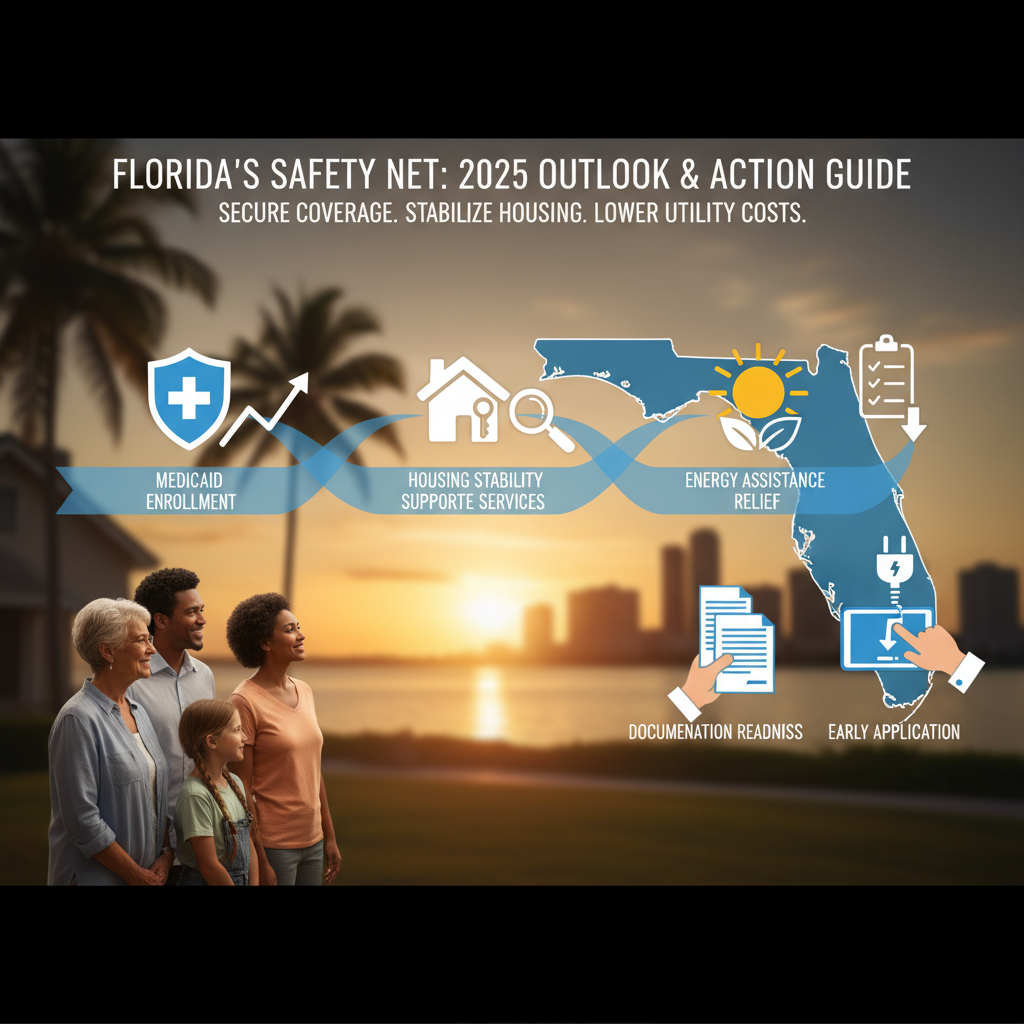
As Florida families, seniors, and caregivers head into the final quarter of 2025, the safety‑net landscape is shifting in ways that matter for health coverage, rent stability, and utility bills. Based on recent national releases and program updates, we see three big currents:
- Medicaid enrollment remains in flux after the end of pandemic-era continuous coverage, with monthly data updates mapping where coverage is rising, falling, or stabilizing.
- Homelessness increased sharply in 2024, highlighting the urgency of connecting people to both housing and supportive services.
- Energy assistance dollars for the 2024–2025 heating/cooling seasons are fully released, but demand tends to outpace funds—acting early is key.
Below we summarize the most relevant developments and offer practical actions you can take now to secure coverage, stabilize housing, and lower utility costs. Our perspective is grounded in national data and policy updates from reliable public sources and homelessness researchers, while focusing on what typically helps low‑income Floridians navigate enrollment and access services.
Medicaid enrollment: Where things stand and why renewals matter now
The federal public health emergency ended in 2023, and with it the continuous Medicaid coverage policy that paused routine disenrollments during the pandemic. Since then, states have been reassessing eligibility and resuming routine renewals. To track what’s happening, the nonpartisan KFF maintains a live Medicaid Enrollment and Unwinding Tracker that is updated monthly with the latest CMS enrollment data. KFF uses February 2020 as a baseline to show how enrollment changed through the pandemic and during the “unwinding” period when states restarted renewals.
Why this matters to you:
- If anyone in your household has Medicaid or CHIP, timely renewal is crucial to avoid gaps in care. Even eligible people can lose coverage if paperwork is missed.
- Coverage levels vary by state and month; the KFF tracker can help you understand national trends and anticipate shifts that may affect local processing timelines.
What you can do now:
- Check your mail, email, and texts for renewal notices from your state Medicaid agency and respond by the deadline. The KFF tracker confirms that monthly data are actively monitored by CMS and states, underscoring that renewals are ongoing.
- If coverage ended and you think you still qualify, submit a new application. Many people who lost coverage during unwinding remain eligible but need to re‑verify.
- If you no longer qualify for Medicaid, exploring subsidized marketplace coverage is typically the next step to prevent gaps; transitions after Medicaid redetermination are a common pathway.
Key takeaway: Renewals are here to stay, and keeping your contact information current with your state Medicaid agency is the single most important step you can take to reduce the risk of losing coverage for procedural reasons. National monitoring via KFF’s tracker confirms the process is active and evolving.
Homelessness rose in 2024—what that means for services and supports
The U.S. Department of Housing and Urban Development’s 2024 Annual Homelessness Assessment Report (AHAR) found that homelessness increased by 18.1% nationwide in the January 2024 point‑in‑time count. According to the National Alliance to End Homelessness’ summary, the rise reflects a mix of factors: ongoing shortages of affordable housing, rising inflation, discrimination, and safety‑net capacity that hasn’t kept pace with need. This is the seventh consecutive year of increases reported by HUD, with marginalized communities, including people of color, overrepresented among those experiencing homelessness.
What this means for Florida households:
- If you or someone you care for is at risk of losing housing, early engagement with local homeless services can improve chances of accessing shelter, rapid rehousing, or supportive housing when available.
- Documenting income, disability status (if applicable), and recent housing history can help providers quickly assess eligibility for programs that use HUD or Medicaid-aligned criteria.
Why service integration matters:
- Research synthesized in “Technically Accessible, Practically Ineligible,” published in the Journal of Health Politics, Policy and Law, shows that implementing Medicaid expansions and related services can still leave chronically homeless adults facing administrative barriers and misaligned eligibility timelines across systems. As summarized by the article’s authors and cited studies, better coordination between health coverage, behavioral health, and housing supports is essential to sustain stability (PMC article).
Practical steps:
- If you are unstably housed, connect with your local homeless services access point (often part of a Continuum of Care) to complete an intake and get on the radar for available supports. Keep copies (digital or paper) of IDs, any disability documentation, and recent notices from landlords or utilities if you have them.
- For seniors and caregivers, ask providers about care coordination and case management options, especially those that support mental health or substance use treatment—the academic literature emphasizes these as critical for long‑term stability (research overview).
Housing supports through Medicaid: progress and caution
States are experimenting with Medicaid to fund services that help people obtain and retain housing. California’s five‑year, $12 billion Medi‑Cal initiative illustrates the ambition: expanded Medicaid‑funded services for unhoused residents include housing navigation, rent deposit aid, and tenancy‑sustaining support through a program known as HTSS. Reporting by American Community Media highlights the scale and scope of these services and the recognition that housing alone is not sufficient without long‑term supports (California initiative overview).
At the same time, program integrity and design matter. In August 2025, the Minnesota Department of Human Services asked federal CMS to approve the termination of its Housing Stabilization Services (HSS) program, citing fraud and inadequate controls, with plans to redesign and relaunch the benefit with stronger guardrails. The move underscores the need for effective oversight alongside access (Minnesota DHS request).
What this means for families and providers:
- Expect continued momentum for Medicaid-financed “non‑medical” supports that address health-related social needs (like help finding housing and sustaining tenancy), but also expect tighter documentation and quality requirements.
- Keep detailed records of services received and ask providers how they document housing‑related supports—clear documentation protects both clients and programs as states strengthen oversight.
Utilities assistance: LIHEAP funding for FY 2025 is fully released—apply early
Energy costs remain a pressure point for low‑income households. The Low Income Home Energy Assistance Program (LIHEAP) provides states with block grants to help eligible households pay heating and cooling bills, avert shutoffs, or manage energy crises. For the 2025 federal fiscal year (which underpins the 2024–2025 and 2025 cooling seasons), the U.S. Department of Health and Human Services announced two funding waves:
- First release: $3.7 billion announced on October 31, 2024 (ACF Dear Colleague Letter)
- Final release: $401.5 million announced on May 1, 2025 (ACF Dear Colleague Letter)
Why this matters now:
- When funding is fully allocated to states, local agencies can commit more awards, but funds are not unlimited. Historically, many eligible households do not receive assistance simply because funding runs out before demand.
- Early application improves your chances of receiving a benefit or crisis assistance if you’re facing a shutoff notice.
Action steps for Florida households:
- Contact your local LIHEAP provider as early as possible for the current program year. Be ready to provide identification, proof of income, and recent utility bills or shutoff notices.
- If you’re in a medical crisis that requires electricity (for example, powered medical equipment), explain this to your local provider—LIHEAP crisis components often prioritize health‑ and safety‑related needs.
How Medicaid, homelessness services, and energy assistance intersect
For many households, challenges don’t arrive one at a time. Health coverage gaps can complicate care for chronic conditions; unpaid utility bills can trigger eviction risk; and homelessness makes it harder to complete eligibility steps or receive mail for renewals. Recent national tracking and reports point to three practical themes:
1) Keep coverage active to prevent cascading crises.
- Monthly monitoring by KFF of Medicaid/CHIP enrollment confirms the renewal cycle is ongoing (KFF tracker). Losing coverage—even temporarily—can interrupt medications or care plans that stabilize health and employment.
2) Pair housing navigation with sustained supports.
- The AHAR 2024 finding of an 18.1% increase in homelessness signals that one‑time placements are rarely enough. California’s Medi‑Cal approach is a prominent example of coupling tenancy supports with navigators and deposit help (California initiative). Research synthesized in the peer‑reviewed literature stresses the importance of aligning program rules across systems to reduce administrative drop‑off among chronically homeless adults (PMC research summary).
3) Apply early for utility help and communicate crisis needs.
- With LIHEAP funds fully released for FY2025 (initial release; final release), program operators can schedule payments and crisis interventions—but early applicants usually fare best. Keep copies of eligibility documents ready to reduce processing delays.
Quality and integrity are evolving features, not afterthoughts
The Minnesota DHS request to end and redesign its HSS program is a reminder that as states expand supportive services, better controls typically follow. According to Minnesota’s statement summarized in local reporting, the intent is to relaunch with “robust program integrity and service quality requirements” (Minnesota DHS request). For households and caregivers, this may mean:
- More structured service plans and verification steps.
- Clearer definitions of what is covered (e.g., housing navigation vs. direct rent).
- Stronger monitoring of provider performance.
From our vantage point working with Florida residents, clearer rules can ultimately help clients get consistent services—so long as enrollment pathways are well-communicated and assistance is available to complete them. The evidence base suggests that services are “technically accessible” only if they are also practically usable by people navigating homelessness or deep poverty, who often face document gaps or unstable contact information (PMC article).
A practical checklist you can use this month
- Medicaid/CHIP renewal:
- Look for mail, email, or texts from your Medicaid agency and complete renewal forms by the stated deadline.
-
If disenrolled, reapply promptly; many people remain eligible but need to resubmit information due to unwinding timelines. Monitor national patterns via KFF’s tracker.
-
Homeless services:
- Complete an intake with your local homeless services access point to be considered for shelter, rapid rehousing, or supportive housing. Bring or safely store copies of ID and any benefit or disability paperwork you have.
-
Ask providers about ongoing tenancy support and case management, not just a placement.
-
Utilities assistance (LIHEAP):
- Apply early for the current program year. The FY2025 funds are fully released (ACF initial release; ACF final release).
-
If you have a shutoff notice or medical risk, tell your LIHEAP provider—most programs triage crisis situations first.
-
Documentation readiness:
- Keep digital photos or scans of IDs, recent income statements, utility bills, and any notices. This reduces repeat trips and speeds up processing across programs.
Our bottom line
- Coverage is in motion, not static. The ongoing Medicaid renewal environment means active follow‑through is essential. Monthly national data via KFF’s Medicaid Enrollment and Unwinding Tracker confirm the stakes.
- Housing need is rising, and the most promising solutions pair stable housing with sustained supports. HUD’s 2024 AHAR recorded an [18.1% increase in homelessness](https://endhomelessness.org/media/news-releases/hud-releases-2024-annual-h