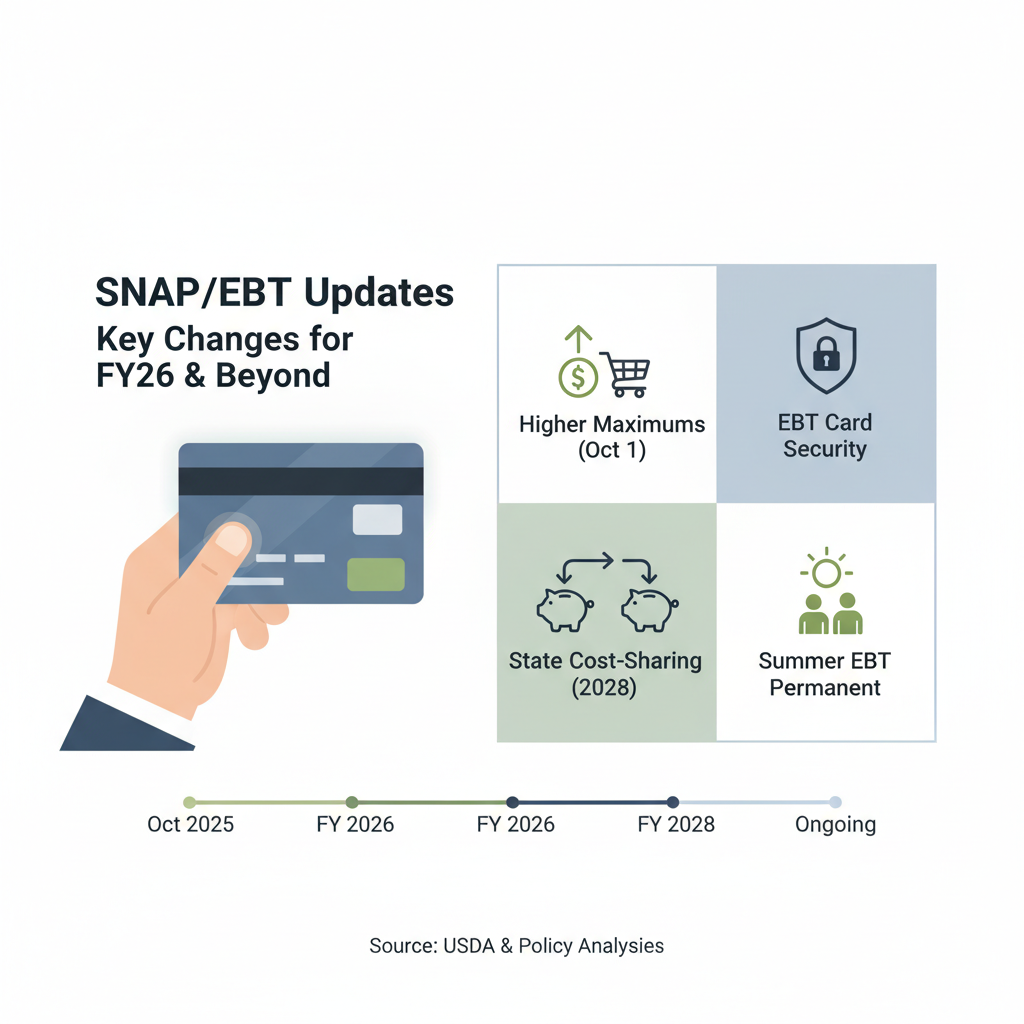
If you use SNAP/EBT or help a loved one manage their benefits, there are several important updates you should know about as we head into federal fiscal year 2026. Below we summarize the key changes, what they could mean for your household budget, and practical steps you can take to protect your benefits and stay enrolled.
What’s changing on October 1: higher SNAP maximums tied to the cost of food
-
New maximum allotments take effect. Each year on October 1, SNAP updates maximum benefit amounts, income limits, and deductions based on inflation. The U.S. Department of Agriculture (USDA) confirmed that the fiscal year 2026 cost-of-living adjustments (COLA) are effective October 1, 2025. According to USDA’s policy memo, the maximum monthly allotment for a family of four in the 48 states and D.C. will be $994. Maximum allotments for a family of four will range from $1,285 to $1,995 in Alaska, $1,465 in Guam, and $1,278 in the U.S. Virgin Islands. See USDA’s FY 2026 memo and numbers here: SNAP FY 2026 Cost-of-Living Adjustments and the associated memo PDF linked on that page.
-
Why benefits change each fall. SNAP uses the “Thrifty Food Plan” to estimate the cost of a modest, nutritious diet for a family of four, then sets maximum allotments from that cost. USDA explains how the COLA process works each year on its SNAP COLA information page, noting that maximum allotments, deductions, and income standards are recalculated annually to reflect the cost of living starting every October 1.
What this means for you
-
Most households should see the new amount reflected in their October issuance. If your benefit amount doesn’t change and you think it should, review your latest notice and contact your state agency. USDA’s National Hunger Hotline is available if you need help understanding your case or connecting to your local agency.
-
Your eligibility rules and deductions also adjust. The October COLA changes not only the maximum allotments but also income limits and some deductions. If your income, household size, or expenses have shifted, make sure your case reflects the most current information so you can be assessed under the updated standards. USDA’s central COLA page describes these annual adjustments.
A major policy shift on the horizon: states sharing SNAP benefit costs starting in FY 2028
SNAP is primarily federally funded, but a law signed in July 2025 (H.R. 1) includes a first-of-its-kind cost-sharing requirement for state governments beginning in fiscal year 2028. Analyses by anti-hunger and education groups outline how this could play out:
-
How the new state cost-sharing would work. As summarized by The Institute for College Access & Success, states with SNAP payment error rates below 6% would not pay benefit costs. States with 6%–8% error rates would pay 5% of benefit costs, those with 8%–10% error rates would pay 10%, and states at 10% or higher would pay 15%, capped at 15%. TICAS notes these tiers are based on FY 2024 error rates and that cost sharing begins in FY 2028.
-
Possible delays if error rates are very high. The Food Research & Action Center (FRAC) explains that if a state’s FY 2025 payment error rate multiplied by 1.5 equals or exceeds 20%, that state may delay its cost-sharing start to FY 2029; a similar calculation using FY 2026 error rates could delay to FY 2030. FRAC’s analysis indicates that, based on FY 2024 data, several states—including Florida—could potentially qualify for this one-time delay if their future error rates meet that threshold.
-
Why this matters for families. These changes do not alter your current eligibility or your monthly October 2025 SNAP issuance. However, FRAC warns the long-term state funding shift could create budget pressure that might affect how states administer SNAP—such as staffing, processing timelines, or outreach—unless lawmakers set aside sufficient funds. TICAS similarly cautions that states could face difficult funding tradeoffs once cost-sharing begins. For now, the best step you can take is to keep your case current and respond quickly to state notices so your benefits aren’t interrupted.
EBT skimming and card security: progress, gaps, and steps you can take
Skimming theft—where criminals capture card data and drain benefits—is still a serious problem. Here’s the latest and what you can do to protect your household:
-
Chip cards are coming slowly. USDA has been working on regulations to require stronger EBT card security as directed by the 2023 appropriations law, but as of late 2024 did not have a firm timeline for moving all states to chip-enabled EBT cards, according to reporting by Nextgov/FCW. Industry groups note that only California and Oklahoma had active plans to transition to chip EBT cards as of July 29, 2025, and USDA reports that more than $94 million has been returned to SNAP households since 2023 to replace stolen benefits, per the National Association of Convenience Stores’ issue brief.
-
Tools states can adopt now. The USDA Office of Inspector General reported in September 2025 that USDA urged states to prioritize practical protections like blocking common PINs, enabling card “freeze/lock” features, sending transaction or PIN-change alerts, and allowing households to block certain types of transactions—alongside public education on EBT safety. These tools can dramatically reduce theft from basic skimming tactics.
-
What you can do today:
- Change your EBT PIN regularly and avoid common PINs like 1234 or 0000. USDA has encouraged states to block these, but it’s still smart practice. See OIG’s summary of recommended tools and practices.
- Use card freeze/lock and alerts if your state offers them. Many states are adding these features; watch your agency notices for details or ask customer service about card controls.
- Inspect card readers. Avoid swipers or keypads that look loose, misaligned, or bulky. Cover the keypad when entering your PIN.
- Monitor your balance and transactions frequently. Report suspicious activity immediately to your state’s EBT customer service line and your local agency. USDA’s National Hunger Hotline can help connect you to assistance if you need help reporting theft.
- Act quickly if benefits are stolen. While policies vary by state and time period, USDA and states have replaced significant amounts lost to theft in recent years; prompt reporting improves your chances.
Summer EBT for families with children: now permanent, with yearly planning
-
Permanent nationwide program. The Consolidated Appropriations Act, 2023 authorized a permanent Summer Electronic Benefit Transfer (Summer EBT) program beginning in 2024. USDA’s guidance explains the administrative funding and planning process states and certain tribal organizations use to operate Summer EBT, with interim regulations and subsequent guidance shaping program details.
-
Yearly plans continue. States must submit annual plans and may seek waivers on timelines as they build the program, as seen in public updates like Colorado’s 2025 Plan for Operations and Management waiver request. USDA’s Summer EBT administrative funding process memo outlines how planning and implementation have been supported in FY 2024 and notes program regulations and guidance for FY 2025 and beyond.
-
What this means for families. If your child receives free or reduced-price school meals, Summer EBT can help cover grocery costs when school is out. Watch for notices from your state human services or education agencies in late spring each year with enrollment or automatic eligibility details. If you’re unsure whether your family is included, use the USDA National Hunger Hotline to get connected to the right state office for answers.
Practical steps to keep SNAP on track this fall
-
Report changes promptly. Because income eligibility standards and deductions are adjusted each October, it’s important that your household size and income information is up to date. USDA’s COLA page explains that these standards reset every October 1.
-
Check your October issuance. The new maximums (e.g., $994 for a family of four in the 48 states and D.C.) start with October benefits. If you have questions about your household’s amount, reach out to your state agency. USDA lists the National Hunger Hotline as a resource if you need help navigating who to contact.
-
Budget with realistic amounts. If you’re planning your monthly groceries, use the posted maximums as a ceiling, not an expectation. Many households receive less than the maximum depending on income and deductions. If your costs have risen sharply and you think your deductions (such as those that may apply in some cases) are not being counted, call your caseworker to review.
-
Stay alert for policy notices. Over the next few years, states will be responding to federal changes in card security and the 2028 cost-sharing shift. You may see new EBT card features (like PIN rules or card locks) or receive notices about processing changes. Read everything your agency mails or texts and act by the stated deadlines.
How these trends may affect Florida households
-
October 2025 benefit updates apply here. The COLA is national. Households in Florida should see October adjustments consistent with the federal changes outlined by USDA.
-
Monitoring the 2028 cost-sharing rule. Florida’s error rates in recent years have been elevated along with many other states. FRAC’s analysis suggests Florida could be among states that qualify for the one-time delay under the law’s formula, depending on FY 2025 or 2026 data. That does not change your current benefits, but it underscores why Florida agencies will be focused on error reduction and process improvements between now and 2028.
-
EBT security will remain a priority. With only a few states moving to chip cards as of mid-2025, Florida households should assume magnetic-stripe EBT security practices still matter. Follow the OIG-recommended steps to protect your card and take advantage of any new tools the state rolls out.
Where to get help and the latest updates
-
USDA SNAP COLA hub. For official information about the October 1 updates to maximum allotments, income standards, and deductions, see USDA’s SNAP Cost-of-Living Adjustment page and the FY 2026 memo and figures.
-
National help line. If you’re unsure how to reach your local office or need help understanding a notice, call the USDA National Hunger Hotline. The Hotline can connect you to state and local assistance resources.
-
Summer EBT developments. For how the permanent Summer EBT program is being funded and implemented, see USDA’s Summer EBT administrative funding process memo. Watch for state-specific announcements each spring about eligibility and distribution.
Our view: what matters most right now
-
The October COLA is real and meaningful. While the maximums don’t automatically apply to everyone, they do reflect USDA’s recognition that groceries have gotten more expensive. Check your October deposit, and if it looks off, ask questions.
-
Keep your EBT card secure. Skimming isn’t over. Until chip cards become standard, the most effective defenses are your PIN habits, card controls, transaction alerts, and fast reporting of suspicious activity. NACS’ summary and USDA OIG’s recommendations both point to practical steps that reduce theft.
-
Watch the long game. The 2028 state cost-sharing requirement won’t change your October 2025 benefits, but it could shape how states prioritize staffing, technology, and outreach. Analyses by TICAS and FRAC are clear: states will be under pressure to lower error rates and manage budgets. That makes it even more important for households to keep documentation handy, respond quickly to requests, and use official channels.
Healing Tampa Bay will continue tracking USDA memos and credible analyses so seniors, caregivers, and families across Florida have clear, timely guidance. If you need assistance navigating these changes or connecting to services, start with the USDA SNAP COLA information, the FY 2026 adjustments memo, and the National Hunger Hotline—and keep an eye on state notices this fall.