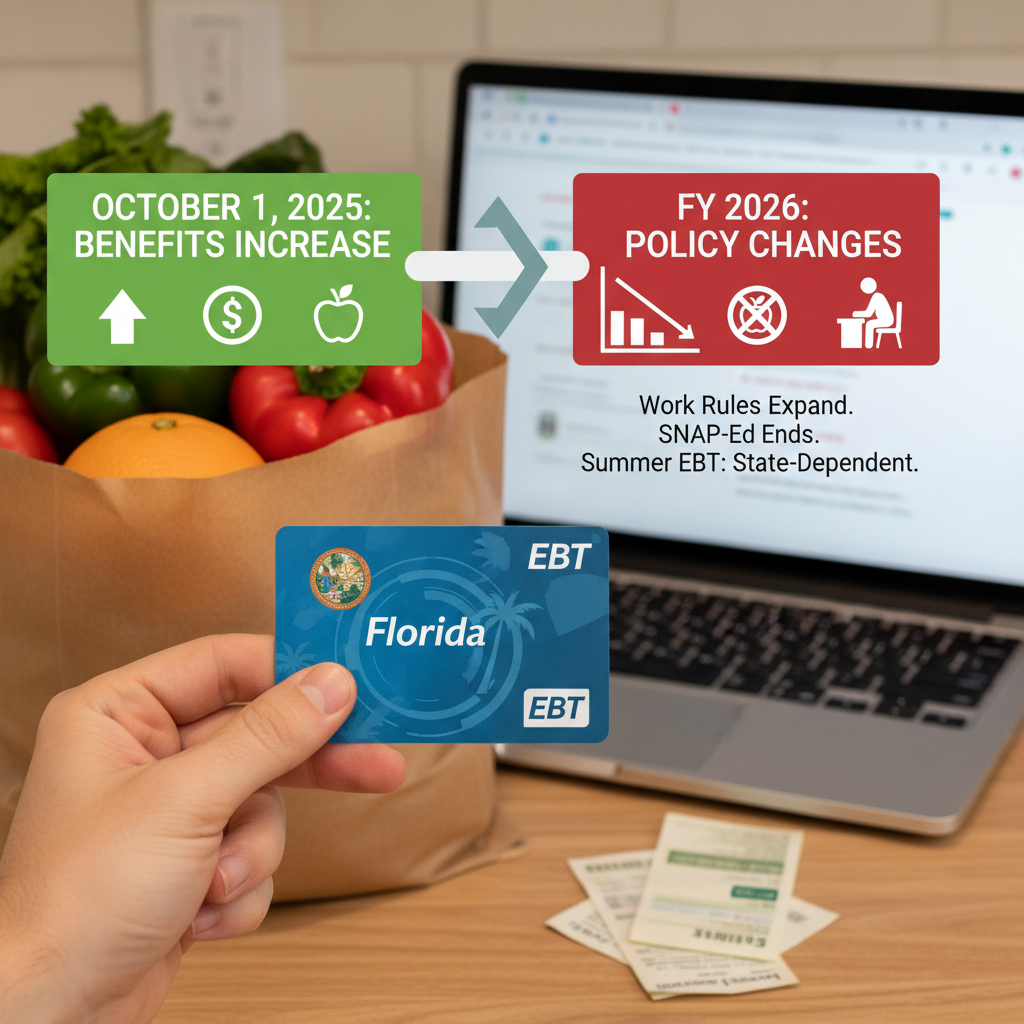
If you rely on SNAP/EBT in Florida—or help a loved one who does—there are two big developments to act on this fall:
- SNAP benefit amounts are going up on October 1, 2025 due to the annual cost‑of‑living adjustment (COLA).
- Congress passed major SNAP policy changes in July 2025 (as part of H.R. 1) that expand work rules and end SNAP‑Ed funding starting in FY 2026, which could affect eligibility and support services.
Below we summarize the confirmed changes from USDA and national policy groups, explain how they may affect Florida seniors, low‑income families, and caregivers, and outline practical steps to protect your benefits.
What’s changing October 1, 2025: FY 2026 SNAP COLA increases
USDA updates SNAP every October to keep up with food prices. According to the official memo on the SNAP Fiscal Year 2026 Cost‑of‑Living Adjustments, the new amounts are effective Oct. 1, 2025. Key figures:
- For the 48 states and D.C. (which includes Florida), the maximum allotment for a family of four will be $994 per month in FY 2026.
- USDA notes maximum allotments will increase in the 48 states and D.C., Alaska, Guam, and the U.S. Virgin Islands; examples in the memo include $1,465 for a family of four in Guam and $1,278 in the U.S. Virgin Islands, with Alaska ranging from $1,285 to $1,995 depending on location (USDA’s FY26 COLA page).
What this means for you:
- If your household has little or no countable income and qualifies for the maximum allotment, you should see the higher amount on your EBT card starting with your October issuance.
- If your household has countable income, your benefit will be recalculated; many households still see a modest increase due to higher maximums and updated deductions each October. USDA’s memo confirms updates to “maximum allotments, income eligibility standards, and deductions” beginning Oct. 1, 2025 (USDA FY26 memo).
Action steps for October:
- Watch for a notice in your case portal/mail about your FY 2026 benefit and income standards. Recheck your October issuance to confirm the updated amount posted.
- Report any rent, utilities, or other allowable shelter costs—these influence your net income through the Excess Shelter Expense Deduction. NACo explains how shelter costs can be used in SNAP budgeting (NACo’s overview).
Major policy changes from H.R. 1 (“One Big Beautiful Bill Act”): work rules, waivers, and SNAP‑Ed
In 2025, Congress advanced reconciliation legislation that significantly tightens several SNAP provisions. The House Agriculture Committee materials and independent summaries chart the path through spring and summer 2025 (House Ag markup page, No Kid Hungry’s legislative summary). The Food Research & Action Center reports that H.R. 1 was signed July 4, 2025 and “makes deep cuts to SNAP,” highlighting the impacts for households and communities (FRAC article).
Based on the National Association of Counties’ breakdown of the enacted content and administrative guidance, here are the SNAP provisions with the biggest implications for Florida residents:
- Expanded work requirements for ABAWDs:
- Under current law, Able‑Bodied Adults Without Dependents (ABAWDs) must work at least 80 hours/month or participate in qualifying programs; non‑compliance can limit benefits to three months in a 36‑month period.
- H.R. 1 expands WHO is considered an ABAWD: adults age 18–65 (up from 18–54), and includes adults with dependents ages 14 and up (previously, having dependents often exempted parents/caregivers). It also eliminates exemptions for veterans, individuals experiencing homelessness, and former foster youth, according to NACo’s analysis.
-
State waiver flexibility is narrowed: waivers can generally only be used in areas with unemployment rates over 10 percent (with special exceptions for Alaska and Hawaii), which means far fewer counties will qualify for relief from time limits or work rules (NACo).
-
Thrifty Food Plan (TFP) adjustments:
- SNAP maximums are tied to the cost of a basic market basket known as the TFP and indexed annually by the CPI‑U.
-
H.R. 1 revokes the 2018 Farm Bill’s mandatory five‑year market‑basket revaluation schedule, placing revaluations at USDA’s discretion, while retaining the annual inflation adjustment (NACo overview).
-
SNAP‑Ed eliminated beginning FY 2026:
- SNAP‑Ed—nutrition education that helps families stretch food dollars and make healthy choices—is eliminated starting in FY 2026 (the federal fiscal year that begins Oct. 1, 2025), per NACo.
-
USDA requested in August 2025 that states either close out FY 2025 SNAP‑Ed grants and return unspent funds or submit a plan to use remaining funds by Sept. 30, 2026 (NACo’s guidance note).
-
Scale of cuts and timeline:
- A synthesis from No Kid Hungry notes the House package was estimated to cut roughly $300 billion in SNAP over FY2025–FY2034, with the Senate revising certain provisions under Byrd Rule constraints in June 2025 (No Kid Hungry summary).
- FRAC’s September 2025 analysis underscores that H.R. 1’s changes will reduce access for many and urges mitigation efforts (FRAC).
What this means in Florida:
- More adults will be subject to work hours or qualifying activity. If you are 55–65, a caregiver with a teen age 14+, a veteran, a former foster youth, or experiencing homelessness, you may now face ABAWD rules that previously did not apply in Florida, based on NACo’s description of the expanded definition and removal of exemptions.
- Time‑limit exposure may widen because Florida counties are unlikely to meet the 10% unemployment threshold required for waivers, which NACo indicates is now the main route to flexibility.
- Nutrition education classes and materials funded through SNAP‑Ed will phase out in FY 2026. If you relied on SNAP‑Ed for budgeting, shopping, or nutrition guidance, plan for those services to wind down per USDA’s August 2025 instructions to states summarized by NACo.
Summer EBT: Permanent at $40/child/month, but state participation matters
Congress created a permanent nationwide Summer EBT program beginning in 2024 that provides $40 per eligible child per summer month on an EBT card to help replace school meals when school is out. The Food Research & Action Center’s 2024 guide outlines the program’s structure, noting USDA’s implementation and state administrative responsibilities (FRAC Summer EBT guide). USDA also issued administrative funding guidance to help states launch Summer EBT in 2024 and beyond (USDA Summer EBT admin memo).
Key points for Florida families:
- Summer EBT is state‑administered. In its 2024 snapshot, FRAC reported that 37 states, D.C., all 5 territories, and 2 Tribal Organizations moved forward in 2024—and listed Florida among states that did not participate that first year (FRAC guide).
- The program continues on a permanent basis, but benefits only flow in states (or Tribal Organizations) that implement it. If Florida participates in a future summer, qualifying families would receive $40/month per eligible child during summer months as described by FRAC.
Action steps:
- If you have school‑age children, keep an eye on official Florida announcements each winter/spring about Summer EBT participation status for the coming summer. If Florida participates, confirm your child’s eligibility and whether benefits are automatic based on school meal eligibility or require an application (the administrative details can vary; see USDA’s Summer EBT policy resources).
- Questions right now? You can call the USDA National Hunger Hotline (listed on USDA SNAP pages) for general program information and referrals; you’ll find the hotline referenced in USDA’s SNAP and Summer EBT resources such as the FY 2026 COLA page.
Practical to‑dos to protect your household’s SNAP
Given the October COLA and the new federal rules, here’s a conservative, Florida‑focused action list grounded in the sources above:
1) Reconfirm your October 2025 issuance.
- COLA increases are automatic. Compare your October benefit to September. If it looks off, review your case notice and check whether your reported income or deductions changed as USDA updates standards annually (USDA FY 2026 COLA).
2) Document your work or qualifying activities if you could be considered an ABAWD under the new definition.
- If you are age 18–65 and do not care for a child under 14, you may be subject to work requirements—even if you are a veteran, experiencing homelessness, or a former foster youth, because those exemptions are removed in H.R. 1 per NACo.
- If you are a caregiver with a teen 14 or older, you may also fall under the expanded ABAWD definition, based on NACo’s summary. Track hours and keep documentation to avoid time limits.
3) Maximize allowable deductions.
- The Excess Shelter Expense Deduction can lower your countable net income if you document rent, utilities, and eligible shelter costs. NACo’s program primer highlights this deduction as part of SNAP’s budgeting rules (NACo overview). Save bills and receipts and report any increases promptly.
4) Plan for the loss of SNAP‑Ed in FY 2026.
- If you use SNAP‑Ed classes or materials, expect these to wind down starting Oct. 1, 2025, consistent with USDA’s August 2025 instructions summarized by NACo). Ask your current SNAP‑Ed provider about any remaining sessions