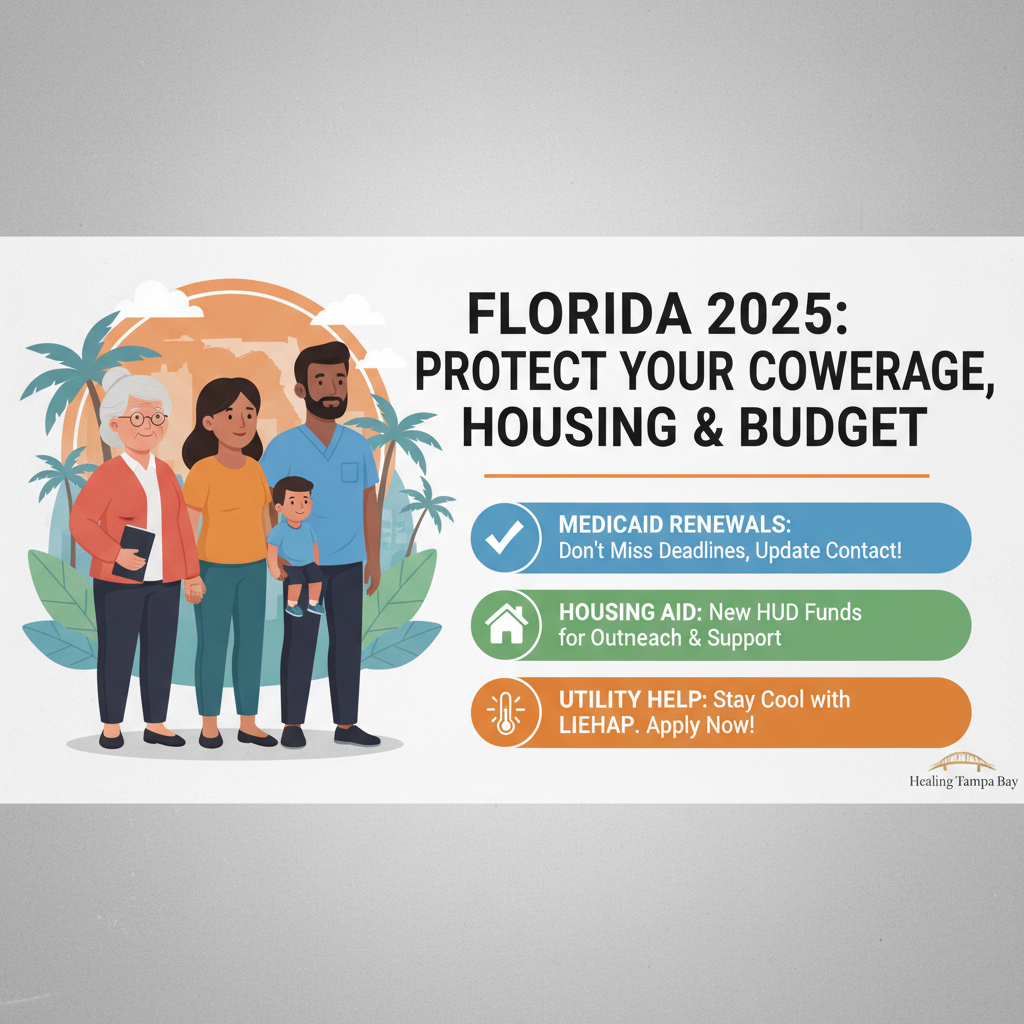
If you’re a senior, a caregiver, or a family living on a tight budget in Florida, late‑2025 brings a mix of urgency and opportunity. Medicaid enrollment is edging down after the pandemic peak, HUD is teeing up a homelessness funding competition that elevates street outreach and recovery services, and federal energy assistance administrators are gearing up to keep households safe through extreme heat and high utility bills. Here’s what’s new—and how to use it to protect your coverage, your housing, and your household budget.
Medicaid enrollment is easing down—don’t miss your renewal
The Centers for Medicare & Medicaid Services (CMS) reports the national Medicaid + CHIP rolls dipped from 78.4 million in April to 78.1 million in May 2025 as states continue post‑pandemic renewals. According to CMS’ May Snapshot, there were 70.8 million enrolled in Medicaid and 7.3 million in CHIP in May 2025, with 40.9 million adults and 37.2 million children covered (CMS May 2025 Snapshot). Between May 2024 and May 2025, adult Medicaid enrollment fell by about 2.0 million (5%), while children’s Medicaid/CHIP enrollment declined by about 830,000 (2%), but both remain well above pre‑pandemic levels.
Why this matters in Florida: Florida’s May 2025 counts show 1,302,576 adults on Medicaid and 2,397,034 children on Medicaid/CHIP (CMS May 2025 state table). Both adult and child numbers dipped modestly from April (adults down ~0.3%; children/CHIP down ~0.5%) (CMS April 2025 state table).
The risk: procedural (paperwork) terminations. CMS’ eligibility data show states’ disenrollment-at-renewal rates in May ranged widely—from 3% up to 39%—and procedural disenrollments (cases closed for missing paperwork or not responding) ranged from under 1% to as high as 34% (CMS May 2025 Snapshot). Many Floridians who still qualify could lose coverage simply because a notice went to the wrong address or a form wasn’t returned on time.
What to do next to protect coverage
- Watch the mail and respond fast. CMS emphasizes that applications and renewals flow through Medicaid, CHIP, human services agencies, and Marketplaces every month—2.3 million applications were received in May alone (CMS May 2025 Snapshot). Return any requested documents before the deadline to avoid procedural closures.
- Update your contact info. If you’ve moved, changed phone numbers, or are staying with friends/family, make sure your Medicaid agency has your current address so renewal packets and text reminders reach you. A large share of procedural disenrollments stem from out‑of‑date contact information (CMS May 2025 Snapshot).
- If you’re terminated, appeal quickly and reapply. Many families who lose coverage still qualify. CMS data show applications are processed monthly and coverage can be restored if you respond quickly (CMS April 2025 Snapshot).
- For kids: check CHIP. Children often remain eligible even if an adult loses Medicaid. In May 2025, 7.3 million children were in CHIP nationally and 37.2 million children were enrolled across children’s Medicaid and CHIP (CMS May 2025 Snapshot).
Healing Tampa Bay’s take: The numbers tell us paperwork is now the main barrier. We prioritize renewal support—text reminders, document checklists, and application help—because it directly cuts procedural losses. If you received a closure notice, bring it to us; many cases can be fixed.
Homeless services: HUD preparing a 2025 Continuum of Care competition with new emphasis areas
Local homeless systems (Continuums of Care, or “CoCs”) should prepare now. HUD has signaled its intent to publish a Notice of Funding Opportunity (NOFO) for the FY 2025 CoC Program with a focus on treatment and recovery, reducing unsheltered homelessness and returns to homelessness, and boosting participants’ earned income. The Big Bend CoC summarized HUD’s message, noting a historic crisis with approximately 770,000 people experiencing homelessness nationwide and 275,000 unsheltered, and that HUD will support local solutions that increase long-term stability and self‑sufficiency (Big Bend CoC 2025–26 NOFO update). HUD also indicates the NOFO will open opportunities for new project types, including street outreach and transitional housing, and urges CoCs to bring effective partners—faith-based organizations included—into the portfolio (Big Bend CoC 2025–26 NOFO update).
What this means for Tampa Bay families and caregivers
- Near-term: Expect more street outreach and service‑rich transitional options if local providers compete well under the new NOFO emphasis. That can shorten wait times for people sleeping outdoors and create more “bridge” options for households not yet ready for permanent units.
- For providers and advocates: Start assembling data on treatment access, recovery supports, and employment services so your projects align with upcoming scoring priorities. HUD is pushing hard on unsheltered reductions and income gains; prepare to demonstrate impact (Big Bend CoC 2025–26 NOFO update).
Healing Tampa Bay’s take: We support CoC partners to align health coverage, behavioral health access, and income supports with housing placements. Coordinating Medicaid enrollment at outreach and shelter touchpoints will be critical so new HUD‑funded projects can actually deliver healthcare and recovery services for participants.
Medicaid + housing: new federal flexibility to address health-related social needs
CMS continues to broaden ways Medicaid can invest in housing‑related services through Section 1115 demonstrations and “in‑lieu‑of services” (ILOS). A recent policy analysis highlights that California’s CalAIM, renewed through a five‑year 1115/1915(b) package, created a statewide menu of community supports—including housing transition/navigation, tenancy sustaining services, and short‑term post‑hospitalization housing—delivered as ILOS when cost‑effective substitutes for medical care (Sellers Dorsey white paper). Massachusetts’ extended 1115 integrates a Flexible Services Program across managed care and fee‑for‑service by 2025 to address health‑related social needs (HRSN), while Oregon’s renewed 1115 includes statewide HRSN integration (Sellers Dorsey white paper).
Notably, CMS has approved time‑limited rent/temporary housing supports in some states for specific populations. For example, Arizona requested up to 18 months’ rent and Oregon up to six months’ rent for people exiting institutions or experiencing/at risk of homelessness; CMS approvals included rent for up to six months in certain cases (Sellers Dorsey white paper). New Jersey’s 1115 also includes housing transition and tenancy supports for people leaving institutions or high‑risk housing situations (Sellers Dorsey white paper).
What this means for Floridians
- If you or someone you care for is homeless or leaving a facility, ask managed care plans and care coordinators whether housing transition or tenancy supports are available through Medicaid in your area. While approvals and details vary by state, the federal direction is clear: Medicaid can cover certain housing‑related services within guardrails when they improve health outcomes and are cost‑effective (Sellers Dorsey white paper).
- For frontline staff: Screen for housing instability and document health risks—eligibility for HRSN services typically hinges on both housing status and health factors. The white paper outlines CMS’ evolving framework that expects standardized screening and measurement across programs (Sellers Dorsey white paper).
Healing Tampa Bay’s take: The strongest results we see come when Medicaid coverage, care coordination, and housing supports move in step. Where HRSN services are available, we help clients connect the dots between plan benefits, housing navigation, and tenancy stabilization.
Utility relief in extreme heat: LIHEAP gears up for FY 2025
The federal Low Income Home Energy Assistance Program (LIHEAP) is ramping training and technical assistance to keep programs running smoothly in FY 2025—so eligible households can get help faster. The Office of Community Services (OCS) shared that FY 2025 will include webinars, data tools, and policy guidance to streamline administration, building on FY 2024 work like outreach toolkits, data warehouse training, and guidance on vendor refunds and flexibilities (OCS LIHEAP FY25 planning letter).
For context, OCS runs an Extreme Heat dashboard to track how LIHEAP helps households stay safe in high temperatures and maintains a LIHEAP Toolkit with outreach materials for partners (OCS LIHEAP FY25 planning letter). While the planning letter is aimed at grant recipients, it signals operational readiness for this summer’s heat.
Timeline note: OCS’ action transmittal confirms quarterly reporting for FY 2025, with periods ending Dec 31 (due Feb 28), Mar 31 (due Apr 30), Jun 30 (due Jul 31), and Sep 30 (due Oct 31) (OCS LIHEAP FY25 quarterly report AT). For households, that means local agencies are actively tracking performance and funding—apply early, and follow up, especially during peak heat months.
What to do if you’re struggling with electric bills in Florida
- Ask about cooling assistance now. Florida LIHEAP agencies can prioritize crisis and cooling needs during extreme heat. OCS reinforces the use of outreach tools to reach eligible households—if you receive a flyer, text, or call, respond quickly (OCS LIHEAP FY25 planning letter).
- Gather documents upfront. You’ll typically need ID, proof of residence, and income for everyone in your household. Bringing a current utility bill speeds up processing. Agencies aim to streamline, but missing documents can cause delays; OCS emphasizes program integrity and data management in FY 2025 plans (OCS LIHEAP FY25 planning letter).
- Reapply if your situation changes. If you’ve had a recent job loss, medical event, or equipment failure (e.g., AC outage), ask about crisis programs. OCS’ Disaster Flexibilities Hub helps agencies adapt during declared emergencies (OCS LIHEAP FY25 planning letter).
Healing Tampa Bay’s take: We plan around Florida’s heat. If you’re choosing between cooling and medicine, tell us. We’ll help you bundle LIHEAP with SNAP screening and Medicaid renewals to stabilize your budget.
How these threads connect—and how to act today