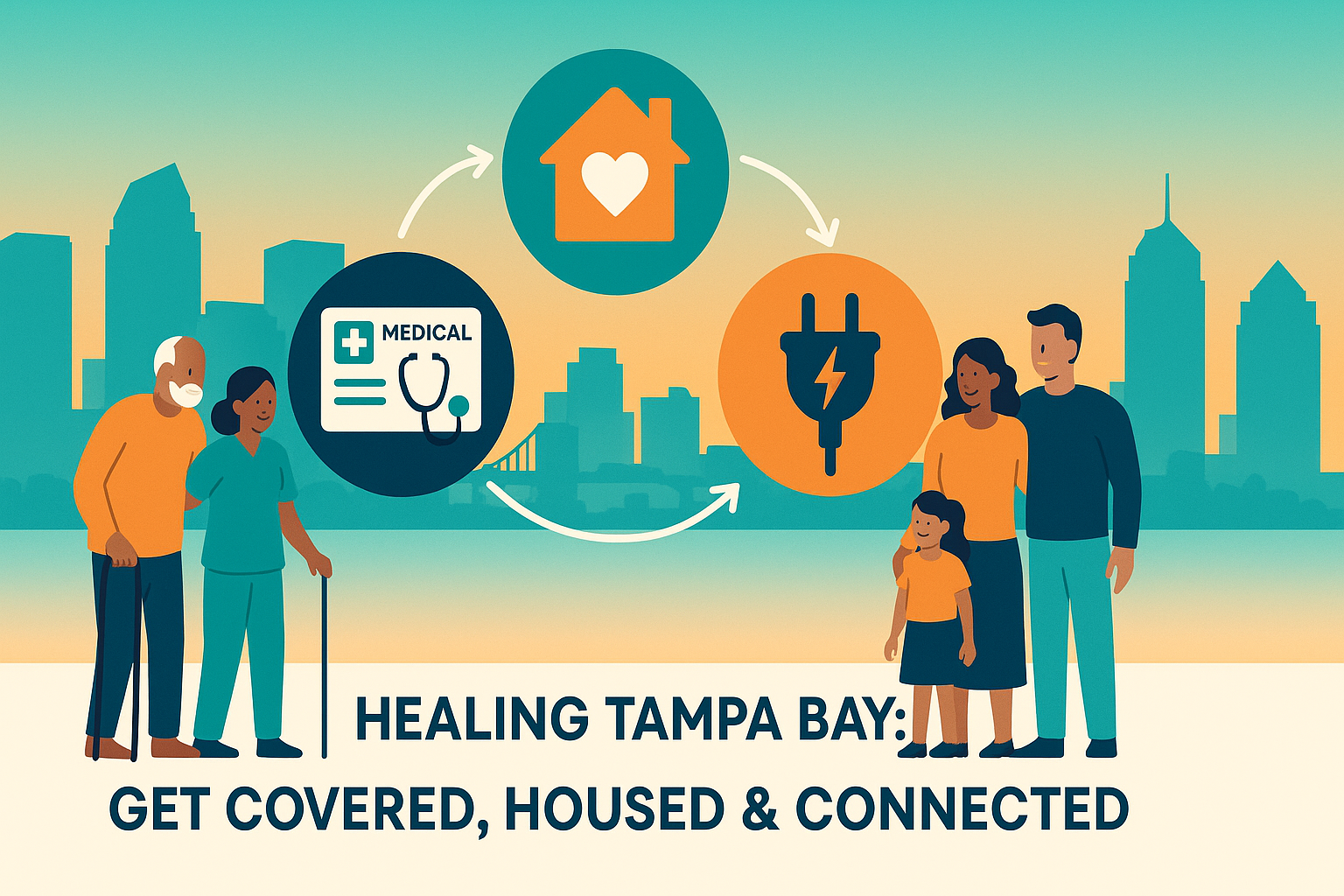
Healing Tampa Bay’s mission is simple: help our neighbors get covered, housed, and connected to the essentials. If you’re a senior on a fixed income, a caregiver, or a family living on a tight budget—or if you’re currently unhoused—navigating Medicaid, homeless services, and utility or housing assistance can feel overwhelming. This guide focuses on what’s working now, how to apply, and what to expect, anchored in up-to-date program information and federal data.
Why this matters: many eligible people never enroll in programs that can stabilize their lives. Research cited by the American Medical Association’s Journal of Ethics found that nearly 75% of Medicaid‑eligible adults experiencing chronic homelessness in 11 cities were not enrolled in Medicaid when reached by clinicians, leaving major health and cost benefits on the table. According to the AMA Journal’s analysis, state Medicaid programs can also fund key “housing-related services” under existing waivers—like helping people prepare for and transition to housing, tenancy supports, behavioral health and substance use treatment, and some transportation—services that are often the difference between a revolving door of crisis care and steady stability.
Below, we outline the core programs and the most practical steps Healing Tampa Bay takes with clients today.
1) Medicaid enrollment when you’re unhoused or on a very limited income
What Medicaid can do right now
- Coverage for doctor visits, hospital care, mental health and substance use treatment, prescriptions, and transportation to care in many cases. As the AMA Journal of Ethics explains, Medicaid funds can support behavioral health and substance use interventions and some transportation, and states can use 1915(c) waivers to fund housing-related supports such as help identifying housing options, transition support, and tenancy services. See the AMA Journal discussion of these Medicaid options and the 2015 CMS guidance summarized there.
- Why to enroll even if housing is unstable: the same AMA Journal source highlights both the high share of eligible but unenrolled individuals and the healthcare benefits of coordinated coverage plus supportive housing. Coverage helps you access care consistently, which also strengthens applications for other programs that benefit from proof of medical need or disability.
How Healing Tampa Bay helps you apply
- Application prep: We help you complete your Medicaid application, get documents in order, and submit forms correctly and on time. If you’re missing items, we help you plan a step-by-step path to obtain or replace them and keep the application moving.
- Coordinating with care teams: Clinicians are encouraged to direct eligible patients to enroll in Medicaid; we work with clinics and case managers to streamline referrals and enrollment follow-through, consistent with the AMA Journal’s recommendations.
- Leveraging covered supports: Where available through Florida’s Medicaid program design, we coordinate with providers offering housing-related supports that Medicaid can fund under existing waivers (eg, housing transition and tenancy services, behavioral health integration, and transportation to medically necessary care), as discussed in the AMA Journal review of federal policy.
Key tip: Even if you’re unsure you qualify, it’s worth applying. The AMA Journal notes that eligibility and enrollment gaps are common, and we find many clients are eligible after all. If an initial application doesn’t go through, we can help you appeal or reapply with corrected documentation.
2) Understanding the homeless services system you’ll encounter
What the federal data shows
- HUD’s Annual Homelessness Assessment Reports (AHAR) provide the best national picture of how people are served and where capacity exists. The 2021 AHAR Part 2 (released July 2023) and the 2022 AHAR Part 2 (released May 2024) explain how communities use Homeless Management Information System (HMIS) data to estimate the number of people who used shelters, rapid rehousing (RRH), and permanent supportive housing (PSH) over a full year and how those services function. These reports detail that communities maintain an inventory of beds in emergency shelters, transitional housing, safe havens, RRH, and PSH and track service use to guide policy and funding.
- The 2015 AHAR Part 1 also shows that HUD tracks the capacity to serve people through the Housing Inventory Count (HIC) and sets methodological standards so Continuums of Care (CoCs) can produce reliable point‑in‑time counts and annual estimates.
What this means for you locally
- Expect a “coordinated” entry point: Most communities organize homeless services through a Continuum of Care that prioritizes scarce resources like shelter beds, RRH subsidies, and PSH placements. Although the AHAR focuses on national reporting rather than local intake steps, it confirms the core types of programs and the system’s capacity tracking, which is what you will interact with on the ground.
- RRH and PSH are not the same: RRH provides short‑term rent help plus case management to help people exit homelessness quickly; PSH pairs long‑term, deeply subsidized housing with supportive services for those with significant disabilities or chronic homelessness. Both are described as part of the annual service landscape in the 2022 AHAR Part 2.
How Healing Tampa Bay helps you navigate
- We triage with you for the fastest path to safety. That can include connections to shelter when available, help engaging with RRH if you qualify, and referrals to PSH providers for those with chronic conditions or disabilities.
- We coordinate with healthcare and benefits enrollment to support housing placement. As the AMA Journal notes, Medicaid can fund services that help with housing transition and tenancy support; integrating your coverage with your housing plan strengthens both.
3) Utilities assistance you can use now: LIHEAP
What’s new, and why it matters
- HHS recently announced $3.7 billion for the Low Income Home Energy Assistance Program (LIHEAP) for FY2025. According to the Administration for Children and Families (ACF), this release includes about $3.6 billion in regular block grant funds under the Continuing Appropriations and Extensions Act, 2025, signed September 26, 2024, plus an additional $100.108 million from the Infrastructure Investment and Jobs Act and redistributed unobligated funds. ACF reports that 90% of the CR funds and 100% of the IIJA funds have been released to grantees with approved plans.
- There is a free online LIHEAP Eligibility Tool launched in 2023 that helps households understand potential eligibility and identify where to apply, as noted by ACF in the same announcement.
What LIHEAP typically helps with
- Home energy bills: preventing shutoffs, restoring service, or reducing high burdens.
- Weather-related crises: depending on local program design, funds can prioritize heating or cooling needs during extreme weather periods.
- Energy efficiency-related supports may vary by community and funding stream.
How to take action today
- Use the LIHEAP Eligibility Tool referenced by ACF to check potential eligibility and find the correct local provider to accept your application. Start here: the ACF announcement explaining the tool and FY2025 funding is available on the ACF website.
- Apply early and respond quickly: Funding is finite and often runs on a first-come, first‑served timeline locally. If you get contacted for follow‑up, reply as soon as possible so your application doesn’t stall.
- Healing Tampa Bay can help you complete LIHEAP applications and align with other supports (for example, Medicaid-covered non‑emergency transportation to a cooling center or clinic if appropriate per your health plan and local rules, consistent with the AMA Journal’s discussion of Medicaid transportation supports).
4) Housing assistance: what’s available and how to get in line
What the federal system provides
- Emergency shelter, transitional housing, safe havens: Temporary options to get out of the elements while working toward an exit plan. These programs and bed types are described in HUD’s AHAR materials and Housing Inventory Count summaries. See HUD’s 2015 AHAR Part 1 description of bed inventories and the 2022 AHAR Part 2 for how these services are tracked annually.
- Rapid Rehousing (RRH): Short‑term rental assistance plus case management to quickly move people from homelessness to permanent housing. The 2022 AHAR Part 2 explicitly covers RRH use during the year.
- Permanent Supportive Housing (PSH): Long‑term rental assistance plus supportive services, often prioritized for people with disabilities or chronic homelessness. Also covered in the 2022 AHAR Part 2.
- Why this matters: The AHAR series confirms that these interventions are the backbone of local homeless response, and communities report participation and bed capacity to HUD each year to guide resource allocation.
How Healing Tampa Bay helps you pursue housing
- Coordinated entry referrals: We guide you on how to present your situation clearly so you’re assessed for the right housing pathway (e.g., RRH vs PSH).
- Benefits alignment: Because some supportive housing requires or benefits from having Medicaid in place, we synchronize your Medicaid and housing-related services enrollment to support placement and ongoing tenancy. The AMA Journal emphasizes that Medicaid can fund services that help individuals prepare for and transition to housing and maintain tenancy under certain waivers.
5) Practical enrollment steps we follow together
- Document what you can and don’t delay for what you can’t: For healthcare or utility help, we start your application with the documents you have and identify what’s still needed. The goal is to get you “in the queue” while we secure missing items.
- Keep a single point of contact: We establish one communication channel that works for you (phone, email, clinic contact, shelter case manager) and maintain it so requests for verification don’t get missed.
- Pair programs strategically:
- Medicaid + housing supports: As described by the AMA Journal, Medicaid can cover certain housing-related services and transportation that help stabilize a placement.
- LIHEAP + medical needs: If you have medically fragile conditions, consistent cooling or heating can be vital. We note these needs when appropriate and consistent with program rules.
- Track deadlines and re-certifications: We maintain a schedule for renewals to prevent lapses.
6) What the data says about system capacity—and why we push for early action
- The AHAR reports (2021 Part 2 and 2022 Part 2) explain that communities report annual usage of shelters, RRH, and PSH using HMIS, and HUD aggregates these to guide policy. The 2015 AHAR Part 1 details the inventory of bed types (shelter, transitional, safe haven, RRH, PSH) communities maintain. These sources make clear: resources exist but are limited and prioritize the most acute needs, so applying early and staying responsive increases your chances of timely assistance.
- Program funding windows fluctuate: As ACF’s FY2025 LIHEAP release shows, federal energy assistance is funded and flowing, but it’s ultimately distributed through local providers who may open and close application windows depending on budget and demand.
7) How to get started with Healing Tampa Bay
- Contact us to start a benefits intake. We’ll screen for Medicaid, Marketplace, SNAP, LIHEAP, and local homelessness resources at once, so you don’t miss an option that could stabilize your situation.
- Bring what you have; we’ll work the rest. Many clients delay because they’re missing a document. We help you build the file while your application is in motion.
- We collaborate with clinics and community partners. As the AMA Journal underscores, clinicians play a key role in identifying eligible patients and making referrals; we integrate these referrals so no one falls through the cracks.
Key sources and why we rely on them
- Medicaid and housing-related supports: The AMA Journal of Ethics explains states’ ability, through Medicaid waivers, to fund housing transition and tenancy services, behavioral health and substance use treatment, and some transportation—and documents that up to three-quarters of eligible chronically homeless adults in one study were not enrolled, underscoring the importance of proactive enrollment. See the AMA Journal discussion of Medicaid and homelessness policy and the 75% non‑enrollment finding.
- Homeless services capacity and program types: HUD’s AHAR series shows how communities track annual use of shelters, rapid rehousing, and permanent supportive housing; see the 2022 AHAR Part 2 and the 2021 AHAR Part 2. For program types and bed inventories, see the 2015 AHAR Part 1 overview.
- Utility assistance funding and eligibility tool: ACF’s FY2025 LIHEAP announcement confirms $3.7 billion released nationally, with 90% of regular funds and 100% of IIJA funds already out to grantees with approved plans, and highlights the LIHEAP Eligibility Tool launched in 2023 to help households check eligibility and find where to apply. See ACF’s LIHEAP FY2025 funding release.
Our bottom line
- Enroll in Medicaid now if you might be eligible; it opens doors to care and supportive services that help you keep housing once you get it. The AMA Journal’s analysis makes clear that Medicaid can fund critical services surrounding housing stability, and too many eligible people remain unenrolled.
- Apply for LIHEAP as early as possible; FY2025 funds are live according to ACF, and the Eligibility Tool can point you to the right local office quickly.
- Use homeless-system pathways strategically; AHAR reports confirm that emergency shelter, RRH, and PSH are the core routes communities use. We’ll help you engage the right one for your situation and stay enrolled in benefits that support housing success.
If you’re in Tampa Bay and need help with any of the above, Healing Tampa Bay will walk with you step by step—from application to approval and renewals—so you can