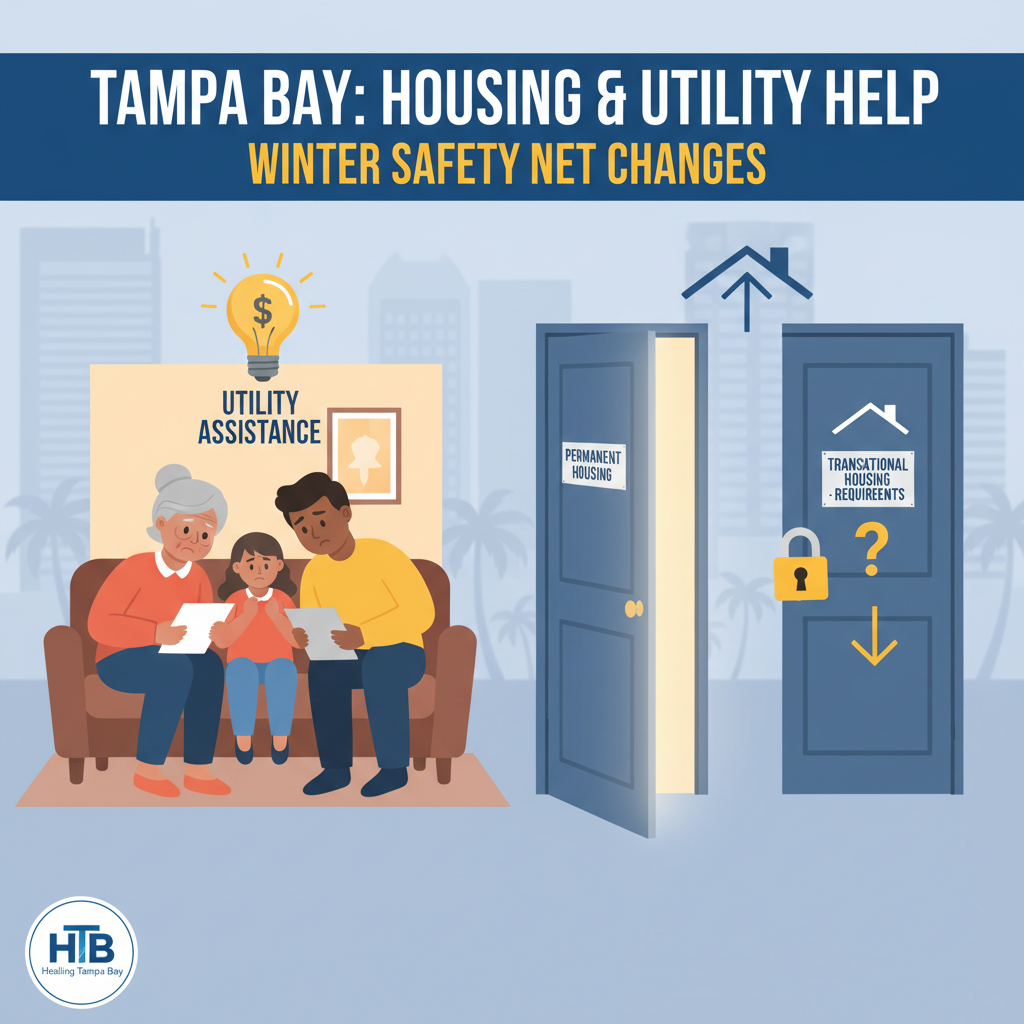
Families and seniors across Tampa Bay are heading into the coldest months and the most expensive utility bills of the year just as major federal safety-net decisions are taking effect. Two developments matter most right now:
- The federal government has released the remaining Low Income Home Energy Assistance Program (LIHEAP) funds for Fiscal Year 2025, meaning states and local administrators should have full-year utility assistance dollars in hand. This is confirmed by the Administration for Children and Families’ Office of Community Services in its Final Funding Release notice, which announces about $401.5 million in FY25 LIHEAP regular block grant funds under the Full-Year Continuing Appropriations and Extensions Act, 2025, signed March 15, 2025. According to the ACF Dear Colleague Letter, “with this notice, OCS has released 100% of the funding available” to recipients with approved plans.
- The U.S. Department of Housing and Urban Development (HUD) has announced major changes in how it funds homelessness programs. Reporting by the Detroit Free Press and MLive indicates HUD is redirecting a large share of Continuum of Care (CoC) dollars away from permanent housing toward transitional housing with service or work requirements. The shift is part of a national HUD funding announcement tied to $3.9 billion in CoC funding.
Below, we break down what these shifts mean in practical terms for Medicaid enrollment, homeless services, utilities assistance, and housing assistance in Tampa Bay—and the steps you can take right now to protect your household.
Utilities assistance: LIHEAP FY25 funds are fully released—apply as early as you can
- What happened: The Office of Community Services within HHS announced the Final Funding Release of FY25 LIHEAP on May 1, 2025. The attached letter confirms approximately $401.5 million in regular block grant funding has been released to states, territories, and tribes. It also notes that 100% of FY25 dollars available under the full-year appropriations act are now in place for grantees with approved plans.
- Why it matters: In plain language, this means Florida’s LIHEAP administrators should be funded for the rest of the federal fiscal year, enabling them to process applications for bill payment assistance, crisis/disconnection support, and (in some programs) weatherization referrals. The funding release timeline and status are tracked on ACF’s LIHEAP Dear Colleague Letters page, which lists both the first FY25 release (October 31, 2024) and this final release.
What you can do now:
- Apply early. Winter months bring higher bills and longer lines. Because funding is finite and demand is high, submit your application as soon as your local LIHEAP office opens its winter intake.
- Gather documents before you go. Requirements vary by local program, but households are commonly asked to provide identification, recent utility bills, proof of income for everyone in the home, and—if applicable—a disconnection notice. Having documents ready helps you get approved faster.
- Ask about crisis appointments. If you’re facing shutoff or have already been disconnected, tell the intake worker up front. Programs often triage crisis cases differently when funds are available.
- Keep your contact info current. If you change phone numbers or addresses mid-process, update the agency to avoid missed appointments or lost benefits.
Healing Tampa Bay can help you understand eligibility, prepare paperwork, and connect with the right LIHEAP intake site in Pinellas, Hillsborough, Pasco, and surrounding counties. Because ACF has confirmed full FY25 funding availability to grantees with approved plans, now is the time to get into the queue.
Homeless services and housing assistance: HUD is shifting funding priorities—expect more transitional housing and fewer permanent housing slots
- What happened: According to MLive’s reporting on HUD’s recent policy changes, the share of CoC-funded projects that are permanent housing would drop from about 87% to 30%, with more funding redirected to transitional housing models that include work or service requirements. The MLive piece cites HUD’s national funding announcement and notes that “70% of projects will again compete for funds.”
- The rationale and debate: The MLive article references HUD leadership aligning the change with a presidential executive order emphasizing “accountability” and “self-sufficiency.” But service providers in Michigan warn the shift undermines what has worked best for chronic homelessness—permanent supportive housing. The Detroit Free Press reports local network leaders fear “a looming crisis,” pointing out that transitional housing often “costs more” and is “less effective” for certain populations, and projecting a drop in supported units in Detroit from roughly 1,800 to 500 if dollars move away from permanent models (Detroit Free Press coverage).
Why this matters for Tampa Bay:
- CoC funding is national. While the news coverage quoted above focuses on Michigan, HUD’s policy and funding notice is national. If similar reallocations and re-competitions occur in Florida CoCs (like Tampa/Hillsborough, Pinellas, Pasco, and nearby areas), local providers could see fewer permanent supportive housing slots and more competition to keep existing projects funded.
- The trade-offs: Permanent supportive housing is widely used for seniors, people with disabilities, and those with long histories of homelessness—groups who often cannot meet work or service requirements. Project transitions to time-limited or requirement-heavy models risk increased shelter stays, unsheltered homelessness, and program churn for the most vulnerable, as flagged by providers quoted by the Detroit Free Press and MLive.
- Concrete impacts seen elsewhere: MLive reports potential cuts that could affect about 7,000 families in Michigan, including 2,000 with children; one county’s combined temporary and long-term housing budget could drop from about $10.2 million to roughly $3.25 million, with an estimated 700 people affected if dollars are eliminated or redirected (MLive analysis). While figures will differ locally, the direction of change is significant.
What you can do now in Tampa Bay:
- If you’re currently housed through a CoC-funded program, stay in close touch with your case manager. Ask whether your program expects to re-compete for funding and whether there are any changes to your housing status or service requirements coming in 2026.
- Keep documentation updated. For any re-certifications or transitions, ensure your ID, disability verification (if applicable), income records, and lease or occupancy documents are current. This reduces the risk of administrative issues causing gaps in assistance if projects change status.
- If you are unsheltered or at immediate risk, ask for diversion or rapid-rehousing screening. Even as priorities shift, many CoCs still operate coordinated entry systems that can evaluate for available slots across multiple programs. The earlier you enter that system, the better your chances to match to assistance that fits your situation.
- Landlords participating in CoC programs should request written updates from provider partners about funding timelines and any anticipated changes.
Healing Tampa Bay can help you navigate coordinated entry, understand program types, and prepare documentation. If you receive a notice about program changes, bring it to your appointment—clarity is key as funding rules evolve.
Medicaid enrollment: no new federal enrollment updates in the sources—keep your coverage active
This update draws solely on the sources listed here. They do not include new federal Medicaid enrollment policy guidance. If you are a Florida Medicaid beneficiary, the best immediate steps are to:
- Watch for and respond to any renewal mail from the state promptly.
- Keep your address, phone, and email up to date with benefits administrators to avoid losing coverage for paperwork reasons.
- Contact Healing Tampa Bay for help with applications, renewals, or appeals if you receive a termination or procedural denial.
We will continue to monitor Medicaid policy changes relevant to Florida and share updates when credible, sourced information is available.
Practical action checklist for Tampa Bay households
Utilities and energy bills (LIHEAP):
- Apply as soon as possible since FY25 LIHEAP funds are fully released to approved grantees.
- Prepare likely documents: photo ID, Social Security numbers if required, proof of all household income, recent utility bill, and any shutoff notice. Requirements vary—your intake worker will tell you exactly what’s needed.
- Ask whether crisis funds are available for disconnections.
- Request information about weatherization or energy education services if offered locally.
Homeless services and housing:
- If you’re currently in permanent supportive housing or rapid rehousing, ask your provider how HUD’s funding changes could affect your program in 2026.
- If you’re unsheltered, enter coordinated entry as soon as you can and keep contact information current to avoid missed referrals.
- If you’re a caregiver supporting a senior or person with disabilities, collect and safely store eligibility documentation (ID, income, disability verification), as many programs re-verify annually.
Medicaid:
- Open mail from benefits offices immediately; many closures happen because forms aren’t returned on time.
- If you missed a deadline, seek help quickly—some terminations can be reversed if you act fast.
Our take: Act early, document everything, and lean on local navigation help
Based on the sources above, two trends are clear and actionable:
- Utility help is funded; families should get in line now. The Office of Community Services explicitly states it has released 100% of available FY25 LIHEAP regular block grant funds to recipients with approved plans, under a full-year appropriations law signed March 15, 2025 (ACF Final Funding Release). That’s as strong a green light as households will get to apply early before lines lengthen and crisis spikes arrive.
- Homelessness dollars are shifting—expect more competition and fewer permanent slots unless local coalitions buffer the change. News coverage by MLive and the Detroit Free Press describes a substantial move away from permanent housing (from about 87% of projects down to 30%) toward transitional housing with requirements, with 70% of projects re-competing. While the exact impact will vary by Florida CoC, households should prepare for potential program transitions and stay closely connected to case managers.
Healing Tampa Bay’s role is to make these systems easier to navigate. We can:
- Screen you for utility assistance and help you gather the right documents.
- Connect you to homelessness coordinated entry and explain the differences between permanent supportive housing, transitional housing, and rapid rehousing so you know what to expect.
- Assist with Medicaid renewals and appeals if you get a notice that’s confusing or incorrect.
If you’re unsure where to start, bring any letters, bills, or notices you’ve received to your appointment. We’ll map out next steps using the latest verified guidance, including federal notices such as ACF’s LIHEAP Dear Colleague Letters and HUD’s national funding announcement, and keep you updated as Florida-specific details become available.
Staying housed and keeping the lights on is possible this winter—especially if you apply early, keep paperwork in order, and use local navigation support.