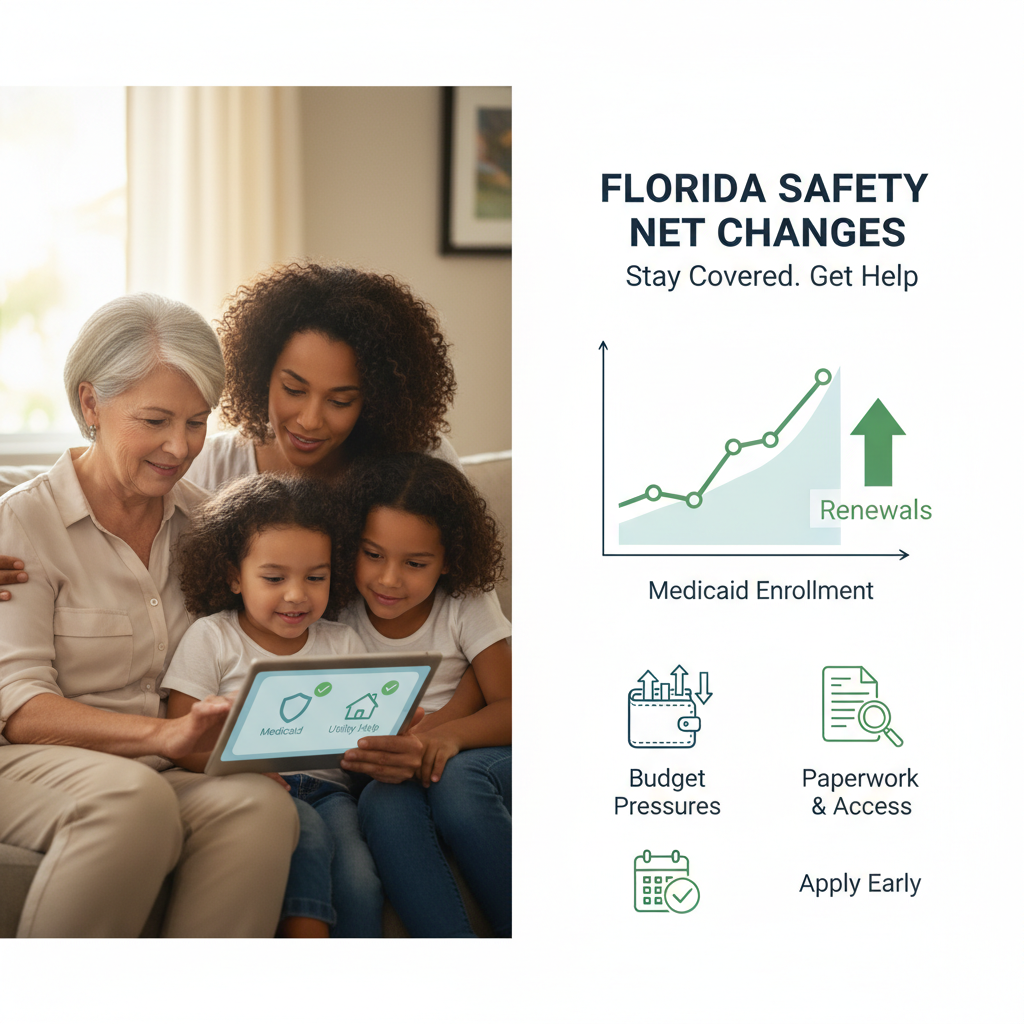
As of November 2025, Florida households face a changing safety-net landscape. Enrollment in Medicaid and CHIP is stabilizing after the pandemic “unwinding,” but budget pressures and policy changes are reshaping what benefits look like and how easily people can keep them. At the same time, federal housing and homelessness policies are in flux, and utility assistance is operating on its yearly funding cycle. This article pulls together up-to-date, reliable information so seniors, low-income families, and caregivers in Tampa Bay can take practical steps to protect coverage and connect to housing and utility help.
Medicaid enrollment is leveling off—but renewals still matter
Nationally, Medicaid and CHIP enrollment has declined modestly from last year as states completed post-pandemic eligibility renewals. According to the Centers for Medicare & Medicaid Services’ (CMS) monthly Snapshots, total Medicaid and CHIP enrollment fell by 2.4 million (3%) between June 2024 and June 2025, with Medicaid adults down 1.6 million (4%) and children/CHIP down 740,000 (2%). Still, enrollment remains higher than before the pandemic: compared to February 2020, Medicaid enrollment is up by 6.3 million (10%) and CHIP by 370,000 (5%) through June 2025, per CMS’s June 2025 Snapshot.
Florida’s trend is similar to the national picture. CMS’s state-level data show Florida had 3,695,066 people enrolled in Medicaid and CHIP in June 2025, down 0.1% from May. That includes 3,529,355 in Medicaid and 165,711 in CHIP (CMS June 2025 data). Earlier in the year, CMS reported that in April 2025 Florida’s enrollment included 1,306,616 adults in Medicaid and 2,408,879 children in Medicaid or CHIP (with 168,379 in CHIP) (CMS April 2025 Snapshot).
Why this matters: the biggest current risk isn’t that Florida will suddenly drop huge numbers of people; it’s that individuals can still lose coverage due to paperwork. CMS reported that in April 2025 renewals, 16% of enrollees were disenrolled and 10% lost coverage for procedural reasons (missing a form or document), levels consistent with March 2025. See CMS’s April 2025 Snapshot.
Action steps to avoid gaps in coverage:
- Watch your mail, texts, and email for renewal notices from your Medicaid plan or the state. Procedural disenrollments are preventable—respond on time.
- Keep your contact information updated with your Medicaid plan so notices reach you.
- If you’re terminated and believe you’re still eligible, request a reconsideration promptly. Many terminations for “paperwork” can be reversed when documents are submitted.
- If you’re no longer eligible for Medicaid, look at Marketplace coverage. CMS tracks Marketplace enrollment alongside Medicaid/CHIP; if you lose Medicaid, you usually qualify for a special enrollment window (source context in CMS Snapshots).
Budget pressures could affect benefits and access in 2026
State Medicaid leaders expect enrollment to be relatively flat, but spending pressures are rising. In its November 13, 2025 news release, KFF reports that states project “flat enrollment post-unwinding but increased spending and budget pressures,” with fewer provider rate increases than recent years and new restrictions emerging in some benefits (for example, coverage of certain obesity medications). Health Management Associates’ roundup the same week underscores that “new federal restrictions on provider taxes” and broader fiscal constraints “place new pressures on Medicaid budgets” and could force trade-offs among coverage, benefits, and provider payments (HMA Weekly Roundup, Nov. 19, 2025).
What this could mean for Florida families:
- Clinics and hospitals may face tighter reimbursement increases, potentially affecting appointment availability or network size.
- States are focused on preserving access to behavioral health and long-term care while modernizing systems and targeting people at risk of homelessness, pregnant people, and justice-involved populations, according to the same HMA/KFF survey summary.
Practical tip: if you rely on medications or specific specialists, keep up with renewals and stay in contact with your Medicaid managed care plan about any network changes. If a medication is denied or coverage rules change, ask for an exception or appeal—plans must explain your rights in writing.
Florida’s supportive housing and behavioral health pilot: what to know
Florida’s Section 1115 Medicaid demonstration—known as the Managed Medical Assistance (MMA) program—was amended in January 2025 and runs through June 30, 2030. Within it, Florida operated a “Behavioral Health and Supportive Housing Assistance Pilot” to provide additional behavioral health services and supportive housing assistance for adults 21+ with serious mental illness (SMI), substance use disorder (SUD), or co-occurring SMI/SUD who are homeless or at risk of homelessness. The pilot operated “through June 30, 2025,” per the federal approval document (CMS approval, amended Jan. 31, 2025).
Key features:
- The pilot required participating Medicaid managed care plans to partner with local housing authorities, community action organizations, and providers, and to coordinate with the Florida Housing Finance Corporation and Florida Supportive Housing Coalition to identify housing options and avoid duplication of services (CMS approval pages 30–32).
- Services included supportive housing assistance aligned with behavioral health needs.
Why this matters now:
- The pilot’s authority was through June 30, 2025. If you are an adult with SMI/SUD who is homeless or at risk, contact your Medicaid plan’s care manager to ask whether supportive housing assistance (or an equivalent service) remains available as part of your benefits. The demonstration itself continues through 2030, but this specific pilot had a June 2025 end date in federal documentation. Confirm current availability with your plan.
If you’re in another state or helping someone outside Florida: similar pilots and supports exist elsewhere under state-specific Section 1115s. For example, New York’s approved waiver includes pre-tenancy and housing transition services—help with locating units, rental applications, lease support, and setting up the new home—for Medicaid Managed Care members (CMS approval letter to New York, Dec. 16, 2024). Maryland’s waiver includes Assistance in Community Integration Services (ACIS) that helps with budgeting for housing, connecting to social services for income, and meeting tenancy obligations (CMS approval, Maryland HealthChoice, Jan. 13, 2025). These examples illustrate what Medicaid can fund to keep medically vulnerable individuals stably housed.
Homeless services: federal policy shifts to watch
Housing advocates are warning that recent federal homelessness funding changes could shift dollars away from permanent supportive housing toward transitional programs and services with work requirements. A November 19, 2025 report by AZFamily states that the U.S. Department of Housing and Urban Development (HUD) issued guidelines shifting federal funding toward transitional housing and drug addiction services with work requirements, with the Maricopa Association of Governments projecting a $32 million loss and nearly 1,400 housing units at risk in Maricopa County (AZFamily coverage).
While that report focuses on Arizona, any nationwide funding reorientation by HUD would ripple through Continuums of Care (CoCs), including in Florida. If HUD’s approach changes procurement priorities, local providers could see fewer dollars for permanent supportive housing and more for short-term beds or transitional programs, affecting how quickly people move from the street to stable housing.
What you can do in Florida:
- If you’re working with a homeless services provider, ask how HUD funding changes are affecting the queue for permanent housing and what alternative pathways they can offer.
- If you receive Medicaid and have a behavioral health diagnosis, ask your plan whether housing-related supports are available and how to access them (see the Florida pilot section above).
- Keep all documents updated (ID, proof of disability if applicable, income or benefits letters). Documentation readiness speeds up both housing and health coverage processes.
Utilities assistance (LIHEAP): funding releases and how to prepare
The Low Income Home Energy Assistance Program (LIHEAP) helps low-income households with energy bills and crisis utility needs. Federal funding is released in tranches each year. For federal fiscal year 2025, the Administration for Children and Families (ACF) announced the first funding release on October 31, 2024 and the final funding release on May 1, 2025 (ACF LIHEAP FY25 DCLs). Program dashboards and funding allocation tables are maintained by ACF (LIHEAP program page).
What this means for Tampa Bay families:
- Local LIHEAP agencies typically open or expand appointments after new federal releases. Slots can go quickly during peak season.
- Prepare documentation ahead of time: recent utility bills, photo ID, proof of address, proof of income for all household members, and, if applicable, proof of crisis (shutoff notice).
- Check the ACF LIHEAP webpage for data and program links, and watch local agency announcements following federal funding releases. ACF’s LIHEAP Data Dashboard provides national/state indicators that may inform local availability.
Tip: If you receive Medicaid, SNAP, or SSI, mention it when applying for LIHEAP; categorical eligibility rules may simplify verification in some jurisdictions.
How these trends fit together—and how to navigate them
Put simply: Medicaid rolls in Florida are steadying, but administrative churn remains a risk; short-term fiscal pressures could tighten certain benefits or provider networks; and homelessness and housing assistance may see federal reprioritization that favors transitional services over permanent housing in some communities. Utility assistance follows an annual funding rhythm that rewards early, prepared applicants.
From an enrollment and access standpoint, here’s a practical, Florida-focused checklist:
- Protect your Medicaid coverage:
- Open every notice from your Medicaid plan. Renew on time—remember CMS found 10% of disenrollments in April 2025 were procedural (CMS April Snapshot).
- Update your address, phone, and email with your plan.
-
If you lose coverage, appeal quickly or explore Marketplace coverage during your special enrollment window (CMS Snapshots track coordination with Marketplaces in the broader ecosystem: see June Snapshot).
-
If you or a family member has SMI/SUD and is homeless or at risk:
- Contact your Medicaid plan’s care manager and ask specifically about supportive housing assistance and behavioral health care coordination; cite the plan’s obligations to coordinate with housing entities as described in Florida’s approved demonstration (CMS approval, pp. 30–32).
-
Ask whether services under the “Behavioral Health and Supportive Housing Assistance Pilot” or an equivalent program are currently available now that the pilot’s authority date has passed (June 30, 2025) per the federal document.
-
Pursue housing help:
- Expect potential shifts in how HUD-funded local programs prioritize beds versus permanent housing placements; ask your case manager what this means for your housing plan, as flagged by AZFamily’s report on HUD shifts.
-
Keep documents ready: government ID, Social Security numbers if available, income/benefit verifications, disability verification if applicable, and any eviction or homelessness documentation.
-
Apply early for LIHEAP:
- After federal releases (latest “final” FY25 release was May 1, 2025), local programs schedule intakes. Track updates on ACF’s LIHEAP page.
-
Bring complete documentation to avoid delays.
-
Budget for possible changes:
- Be aware that state budget pressures may influence benefits and provider networks. KFF’s November 2025 release notes states are facing “increased spending and budget pressures” with some tightening in benefit policies (KFF report release). If a service is reduced or a medication is no longer covered, ask about alternatives, exceptions, or appeals.
A note on specialized programs in other states
While our focus is Florida, it’s useful to know how other states are using Medicaid waivers to address housing and behavioral health needs, because these models often spread:
- Maryland’s HealthChoice waiver includes Assistance in Community Integration Services that support budgeting for housing, connecting to income supports, and meeting tenancy obligations—services designed to keep medically complex people in the community (CMS approval).
- New York’s waiver approval includes detailed pre-tenancy help (housing search, applications, negotiating leases) and move-in coordination (CMS approval letter).
These examples show what Florida plans may be coordinating locally—even when Medicaid isn’t paying rent, it can fund the services that make housing possible for people with behavioral health needs.
Bottom line
- Florida Medicaid/CHIP enrollment sits around 3.7 million (June 2025), with small monthly changes. Don’t lose coverage to paperwork—renew promptly and update contact info, as CMS continues to report significant procedural disenrollments (CMS April and June 2025 Snapshots, June Snapshot).
- Behavioral health and supportive housing coordination through Medicaid managed care has been a key Florida strategy; ask your plan what supports are active now that a pilot’s June 2025 end date has passed (CMS Florida 1115 approval).
- Expect tighter state Medicaid budgets through 2026. Track any plan notices about provider networks or benefit rules, and use appeals when appropriate (KFF Nov. 2025 release; HMA analysis).
- LIHEAP funding for FY25 was fully released by May 1, 2025. Apply early and prepared for energy assistance (ACF LIHEAP FY25 DCL; LIHEAP program page).
- HUD funding priorities may be shifting nationally, potentially affecting permanent housing placements. Stay in close contact with your case manager and keep documents ready (AZFamily report).
Our outreach team’s perspective: in this environment, the most effective strategy is proactive paperwork, frequent communication with your Medicaid plan and housing providers, and applying early for utilities help. These steps reduce the risk of avoidable coverage losses, smooth access to services, and position your household to benefit from available funds—even as policies and budgets evolve.